NordLynx vs OpenVPN: Which Is Faster, and When

NordLynx is faster for almost every connection, and OpenVPN over TCP 443 is the one to switch to when a network blocks UDP and NordLynx will not connect. The gap is smaller than most comparison pages suggest: it shows up in the second or two before the tunnel is up, not in page loads. vpntrail puts NordLynx at about 10,000 lines of code against about 400,000 for OpenVPN, which says more about how much code you trust than about your speed. Pick by what the network lets through.
NordLynx vs OpenVPN at a glance
The table
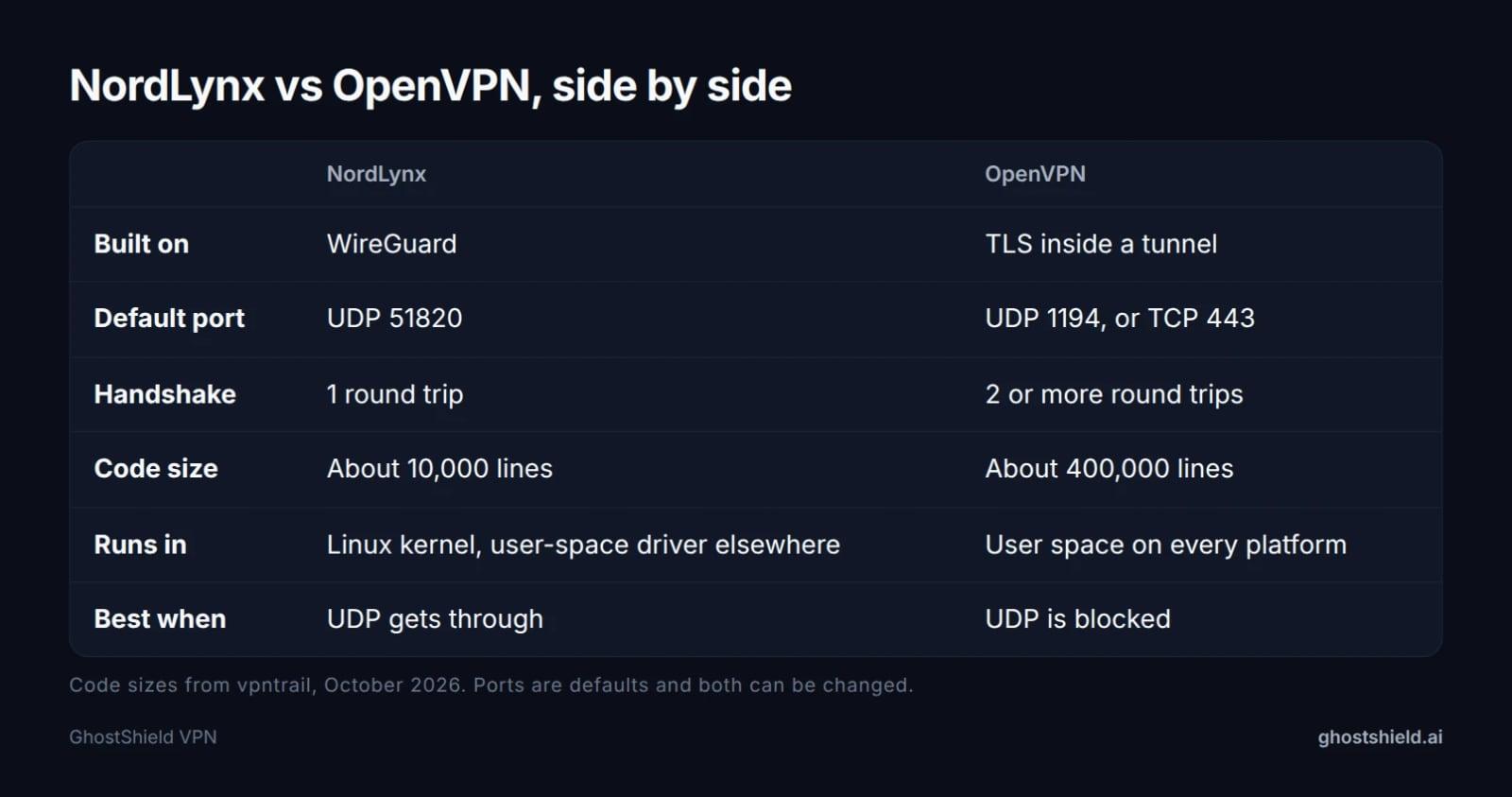 The same comparison, one line per difference. Code sizes from vpntrail, October 2026.
One screen carries the whole answer: transport, default port, handshake, code size and the situation where each one wins. Read the table first, then the detail below it.
Both encrypt your traffic, and neither is more private than the other by design. The protocol decides how your client and the server agree on keys and which port the packets use. It does not decide what the provider records afterwards.
What the table does not tell you
NordLynx is NordVPN's build of WireGuard, so the two are close to the same thing. comparitech treats WireGuard and NordLynx as near-equal in speed and bandwidth. OpenVPN is older and more portable. It still runs on routers, old Android boxes and systems WireGuard never reached, and that compatibility is most of why it survives.
The code size gap is about how much code you have to trust, not about your day to day speed. Fewer lines are easier to review, and more lines buy portability.
The table also cannot see the network you are on. A hotel that blocks UDP makes the faster column unusable, and no amount of benchmark reading changes that.
What NordLynx and OpenVPN actually are
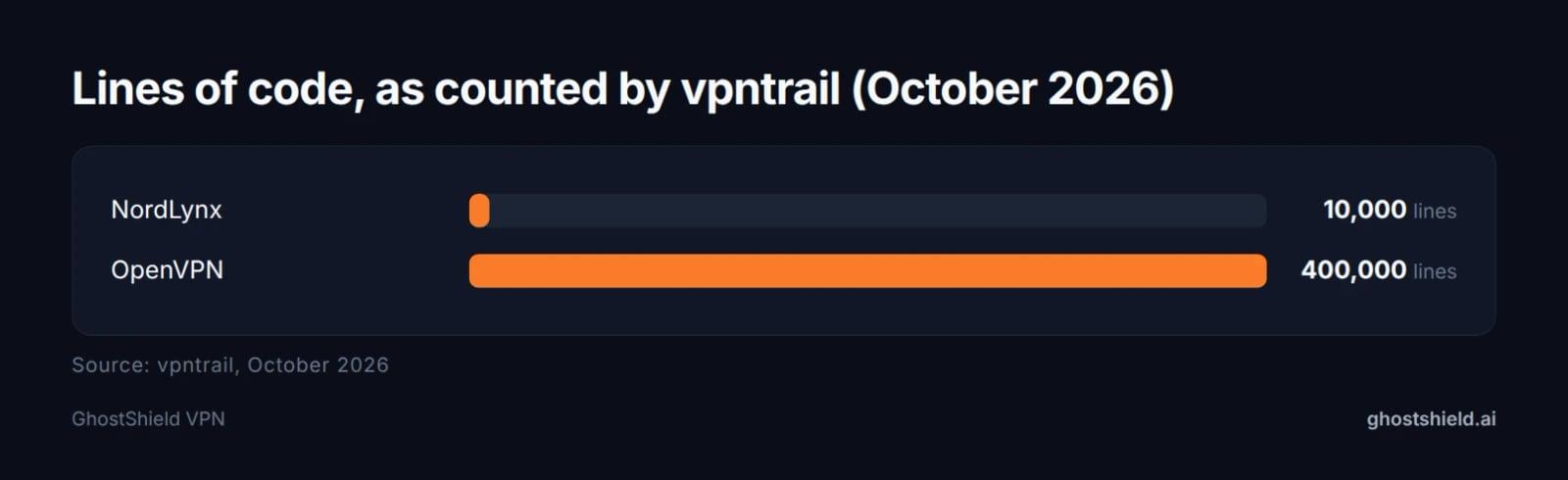 A smaller codebase means less to review. It does not mean fewer features for you.
NordLynx is WireGuard with a double NAT
WireGuard was built with a fixed set of algorithms, so there is nothing to negotiate. Your client sends a handshake initiation with its public key, the server answers with its own, and both derive session keys. That is one round trip.
NordVPN adds a double NAT layer on top. Your traffic reaches a second address inside Nord's network before it exits, and the company describes this as a way to keep the address you connect to separate from the one the internet sees. It changes where traffic leaves, not how many round trips you make.
OpenVPN is TLS in a tunnel
OpenVPN carries a TLS session inside its own tunnel, the same encryption family your browser uses for HTTPS. TLS 1.3 needs two round trips before the first encrypted byte, and OpenVPN adds its own control channel and cipher negotiation on top of that.
Ports differ, and that matters more than speed. WireGuard defaults to UDP 51820. OpenVPN defaults to UDP 1194, with TCP 443 as the fallback that gets through networks which only leave web ports open. Our TLS VPN vs IPsec guide covers how these designs compare with the other big tunnel family.
OpenVPN the protocol, OpenVPN the company, and OVPN the provider
The naming is a mess, and half the first page is confused by it. spotsaas compares NordVPN at $3.29 a month with OpenVPN Access Server at $75 a month, which is a business server product from OpenVPN Inc, not a consumer plan. faun.dev compares NordVPN with OVPN, a different provider again. Neither page is comparing two consumer VPNs you would sign up for today.
On code size, vpntrail counts NordLynx at roughly 10,000 lines and OpenVPN at roughly 400,000. Fewer lines are easier to review, and more lines buy the portability that still gets OpenVPN onto old routers. If you want the WireGuard design compared with a mesh tool, our Tailscale vs WireGuard piece does that.
NordLynx vs OpenVPN speed: where the time goes
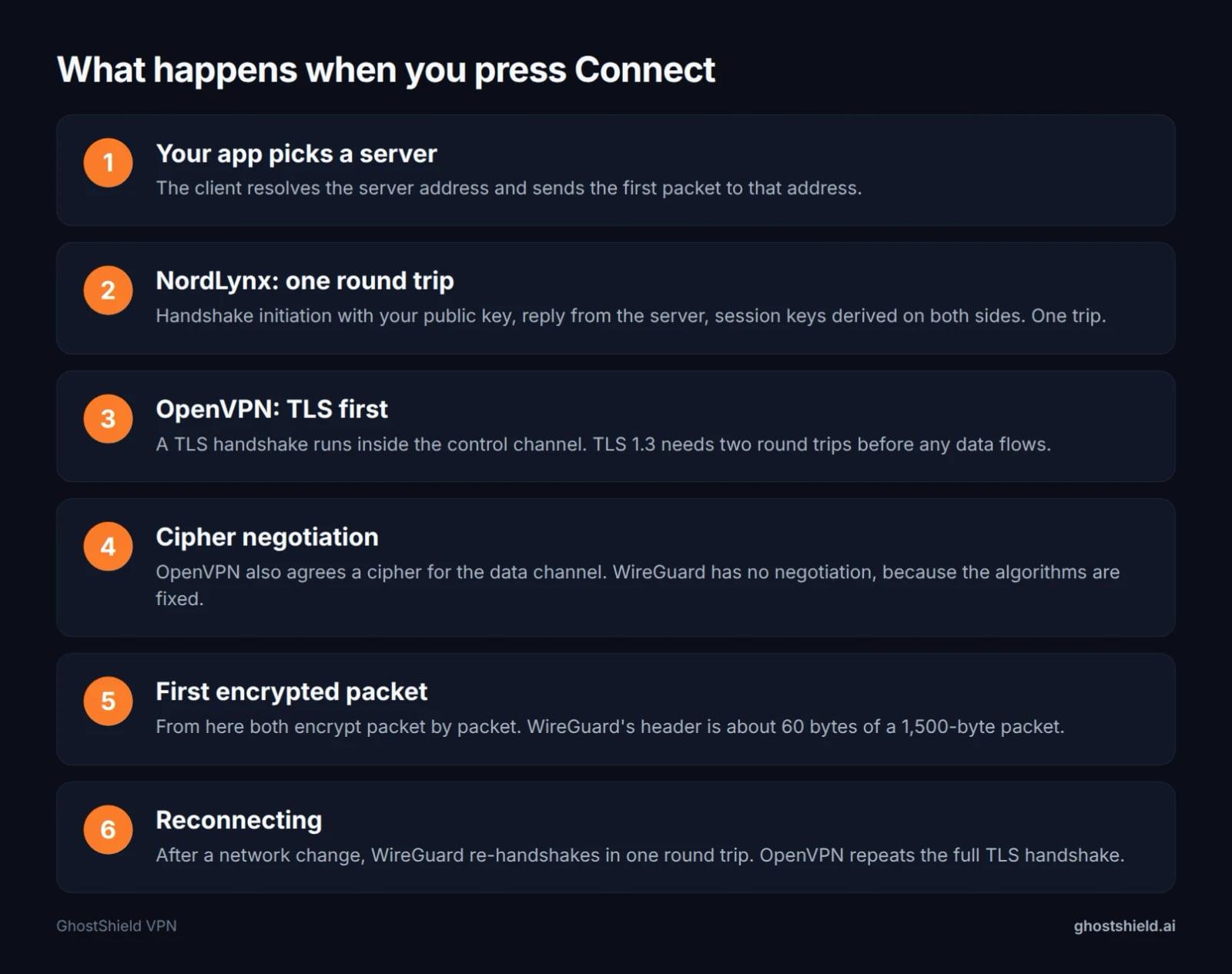 Where the seconds go when you press Connect.
Connection time, not page load
Most speed comparisons come from one test, on one line, on one day. The protocol's share of that number is small. The distance to the server, your CPU and the route in between are large.
Feel it in connection time instead. On a server 150 ms away, two extra round trips add about 0.3 seconds before the tunnel is up. That happens once per connect, not once per page, which is why the gap in a browser is hard to notice.
Overhead is small either way
After the handshake, both encrypt packet by packet. WireGuard's header is about 60 bytes on a 1,500-byte packet, under 5 percent, and OpenVPN's is in the same range. Overhead is not why a video buffers.
| Protocol | Round trips before data | Time at a 150 ms round trip | Header per 1,500-byte packet |
|---|---|---|---|
| NordLynx | 1 | about 0.15 s | about 60 bytes |
| OpenVPN with TLS 1.3 | 2 or more | about 0.3 s or more | similar range |
The TCP trap
OpenVPN over TCP can stall on a lossy line. TCP already retransmits, and OpenVPN's TCP mode retransmits inside that stream, so one dropped packet waits on two timers. The UDP versions do not have that problem, as our OpenVPN UDP vs TCP guide sets out.
WireGuard reconnects in one round trip when your phone moves from Wi-Fi to mobile data. OpenVPN repeats its full TLS handshake, which is the moment you notice on a train.
CPU is the other place the difference shows. vpntrail notes that NordVPN rates OpenVPN average for speed with higher CPU use than NordLynx, and a speed test at bitblokes put NordLynx ahead. Those are their tests, not measurements of ours.
Which is better for your connection?
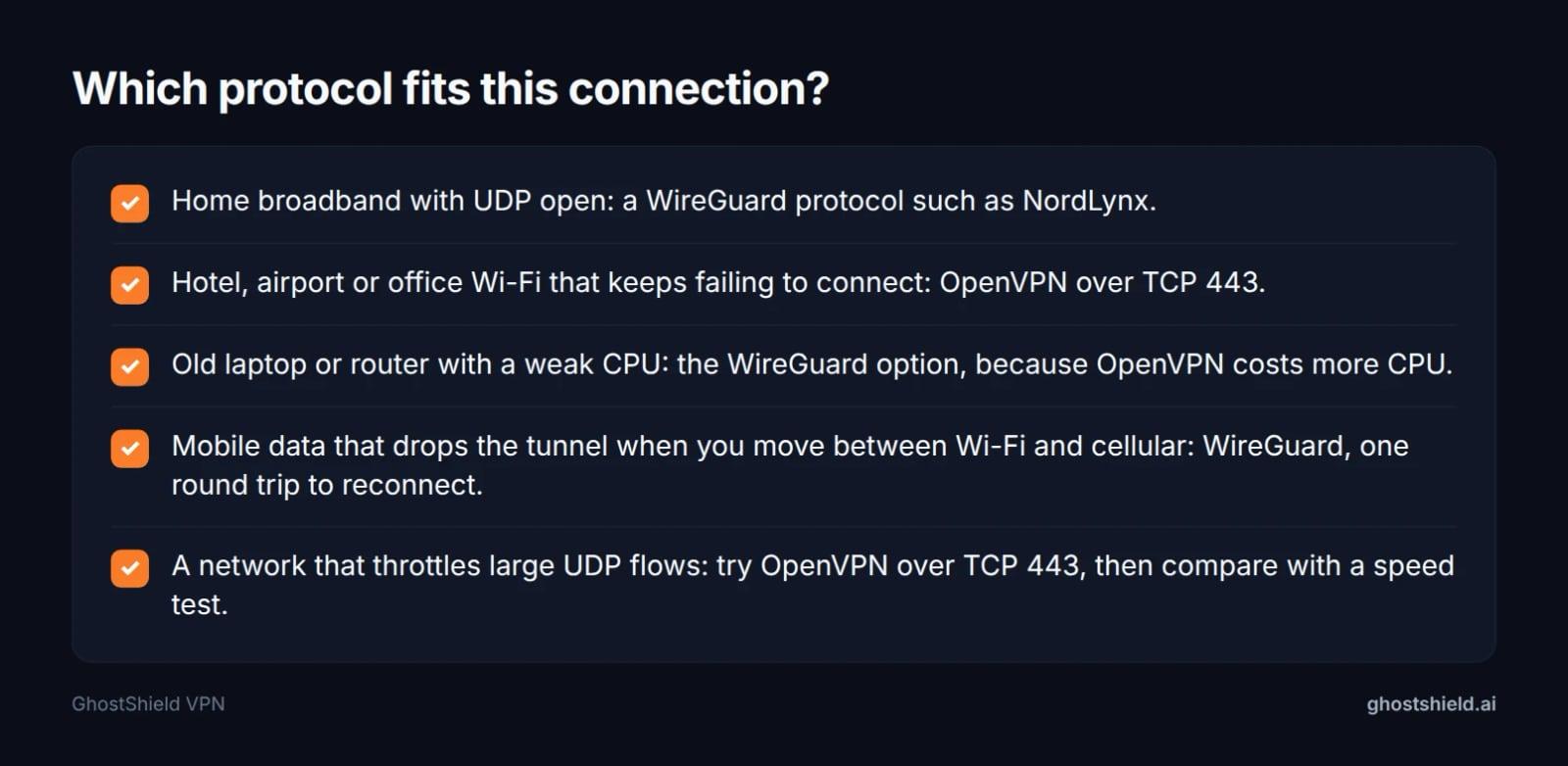 Match the protocol to the network, not to a chart.
The rule
Choose by what the network lets through, not by a benchmark table. A protocol that cannot open a tunnel has no speed to compare.
If you are asking which VPN protocol is best for NordVPN, the short answer is NordLynx for most connections, and OpenVPN over TCP 443 only when NordLynx will not connect. NordVPN recommends NordLynx as the default for most people, and that is a fair default.
When NordLynx is the answer
UDP open, which covers most home broadband and most mobile data: use a WireGuard protocol, which on NordVPN means NordLynx. Old hardware belongs here too. A 2016 laptop or a router will feel OpenVPN's CPU cost more than a new phone will, as vpntrail points out.
When OpenVPN is the answer
UDP blocked or throttled, which covers hotel, airport and office Wi-Fi, some mobile carriers and some countries: switch to OpenVPN over TCP 443. It shares a port with HTTPS, so more networks leave it open, and you accept a slower tunnel in exchange for having one.
A port is not a security setting. Moving 1194 to 443 does not make the tunnel weaker or stronger. Our full list of VPN protocol ports explains what each port is for and how to check yours, and you can compare the result with our VPN speed test. If you are leaving NordVPN for a different reason, our NordVPN alternatives guide sorts those reasons, and the compare VPN guides page lines up the rest.
What neither protocol does for your privacy
 Photo by cnrdmroglu on Pexels
Tracking and legal requests
Both protocols encrypt the payload in practice. Whether anyone can later read records about your session depends on the provider's policy and jurisdiction, not on the handshake. Choosing NordLynx over OpenVPN, or the reverse, does not change that.
Can the FBI track NordVPN? A VPN moves the point where your traffic becomes visible. It does not remove legal process, and a provider can be served with an order. Your accounts, payment records and the sites you sign into all leave traces that have nothing to do with the tunnel.
Hacking, and why a VPN is not armour
Which VPN is best for hackers? None. A VPN hides your traffic from the local network and your ISP, not from the services you log into, and it does not make illegal activity safe. Lists that rank providers for this are selling a mood.
Leaks are a separate problem
Can you still get hacked with a VPN? Yes. Phishing, a reused password, malware you installed and a stolen session cookie all work through an encrypted tunnel. The VPN protects the path, not the endpoints, so start with a password generator and a password strength check.
A tunnel can also be up and still leak. DNS and WebRTC leaks are separate from the protocol choice, so run our DNS leak test after any setup change.
Where GhostShield VPN fits
WireGuard only, and what that rules out
GhostShield VPN runs WireGuard with ChaCha20-Poly1305 and nothing else: no OpenVPN, no IKEv2, no proprietary layer. That puts it in the WireGuard column of every table above.
There is no obfuscation or stealth mode. On a network that blocks UDP, or one that only lets TCP 443 out, it will not connect, and we would rather you know that before the trial than after. For the same reason it is not a tool for censorship. GhostShield VPN is not reliable in China, Russia, Iran or the UAE, and our country guides say so plainly.
What you get
You get servers in 16 countries across 20 locations, 10 devices at once, and apps for Windows, macOS, Android, iPhone and iPad, plus Google TV. Linux and routers work through a manual WireGuard configuration.
Features include a kill switch, DNS leak protection, split tunneling, ad and malware blocking, family mode and AI threat detection. The logging position is a strict no-logs policy: no browsing activity, traffic content, DNS queries or real IP addresses are stored on our servers. Those servers are ordinary virtual servers with normal disks, and no third-party audit has been completed yet, so treat the logging claim as our word rather than a verified fact.
Price is $4.99 a month on the 1-year plan ($59.88 billed yearly), $3.99 a month on the 3-year plan ($143.64), or $6.99 month to month. Every plan starts with a 7-day free trial that charges nothing, a reminder email goes out one to three days before it ends, and a 30-day money-back guarantee covers it if the service is not for you. See GhostShield VPN pricing.
FAQ
How do I get rid of NordLynx?
Quit and uninstall the NordVPN app, then reboot, and the virtual adapter usually goes with it. If one is left behind, open Device Manager, find it under Network adapters and remove it. You cannot keep NordLynx without the app, because it is a driver the app installs.
Why do people avoid NordVPN?
The usual reasons are renewal pricing, a very large marketing footprint, and NordLynx being a closed layer you cannot inspect or swap for stock WireGuard. It is a capable product for many people. Whether those trade-offs matter is your call.
What are the top 3 best VPNs?
We do not rank other providers. Published lists disagree because each one weighs price, speed and streaming differently. The useful version is three checks: which protocols a provider offers, what it logs and where its servers are. Run those and you have an answer that fits your connection.
Is it bad to leave a VPN on all the time?
No, it is generally fine. The costs are battery on mobile, occasional friction with banking or streaming sites that treat data-centre addresses with suspicion, and a little latency. Turn it off, or use split tunneling, for local devices such as printers and casting.
What is the most secure and free VPN?
No free VPN is both secure and sustainable, because servers and bandwidth cost money, so free services tend to cap data, show ads or monetise what they can see. GhostShield VPN has no free plan. It has a 7-day free trial that charges nothing, then a 30-day money-back guarantee.
Related Topics
Keep Reading
OpenVPN vs Tailscale: Which One Fits Your Job? (2026)
IKEv2 vs IKEv1: What Still Matters in 2026

Best VPN Services 2026: Pick by What You Pay It For
VPN Protocol Ports: Full List and How to Test Yours

Tailscale vs WireGuard: Which Do You Actually Need?