IKEv2 vs IKEv1: What Still Matters in 2026
IKEv2 vs IKEv1 comes down to four practical differences. IKEv2 has NAT traversal built in, MOBIKE so a tunnel survives a change of network, a four-message setup instead of six, and inline rekeying instead of tearing down and re-authenticating. IKEv1 is the 1998 version, published as RFC 2409. IKEv2 is the 2014 successor, RFC 7296. Both negotiate an IPsec tunnel, so the choice is about how that tunnel is built, not whether your traffic is encrypted.
IKEv2 vs IKEv1: the short answer
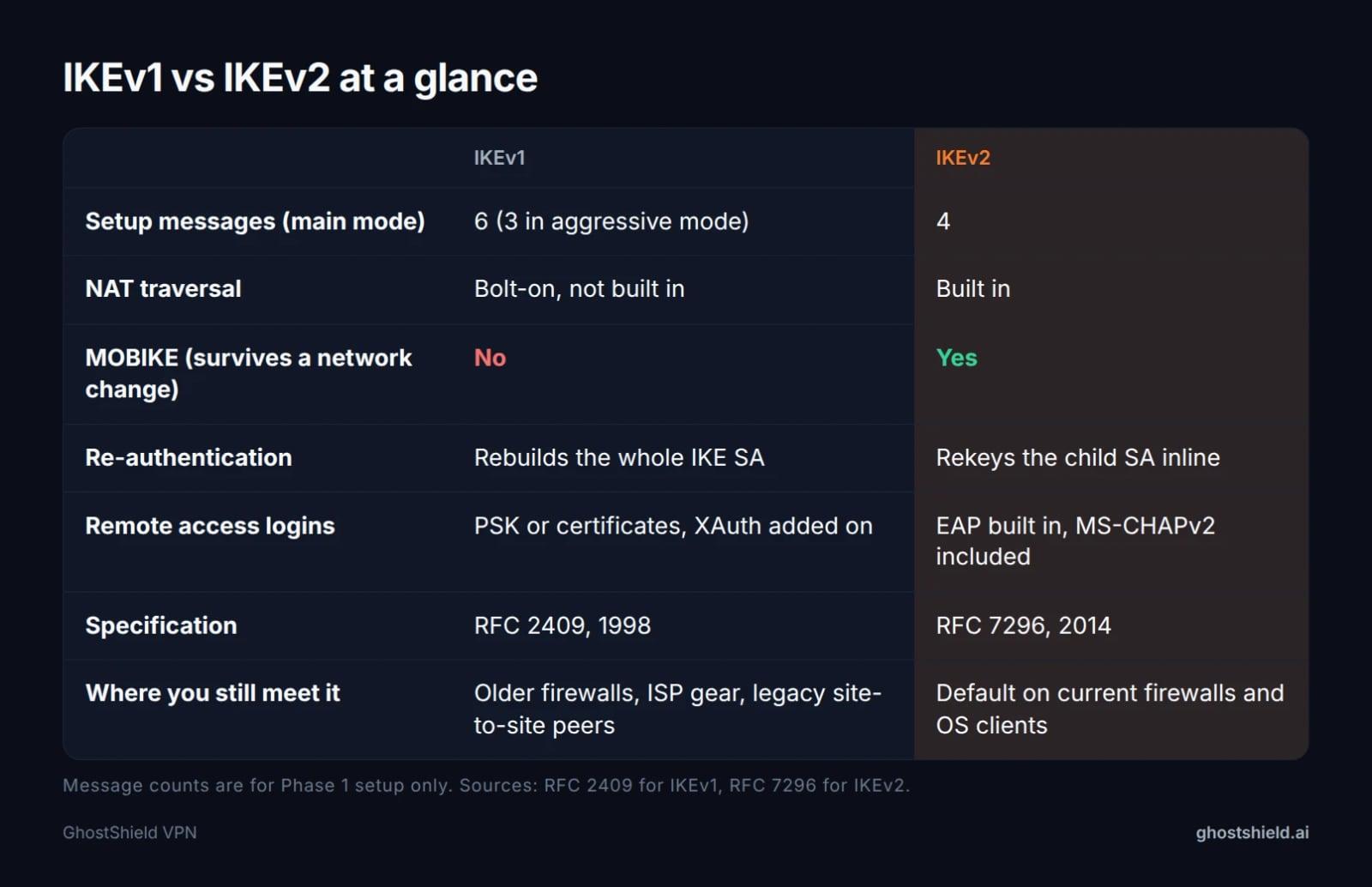 The four differences that matter in daily use, plus the ones that only matter in a config file.
IKEv2 adds three things IKEv1 never had properly: NAT traversal built in, MOBIKE so a tunnel survives a change of network, and a four-message setup instead of six. RFC 7296 is the document to read if you want the detail.
IKEv1 still works and still turns up on older firewalls and at the far end of some site-to-site links. It was published in 1998 and has not been formally withdrawn.
One distinction saves a lot of confusion. IKE is only the negotiation. IPsec is the part that encrypts and carries your traffic. IKEv2 negotiates an IPsec tunnel, it is not an alternative to one.
If you run an app based VPN rather than a firewall, this question may never reach you. GhostShield VPN runs WireGuard only, so there is no IKE version to choose and no proposal list to edit.
What IKEv2 actually fixed
MOBIKE: the tunnel follows the device
MOBIKE (IKEv2 Mobility and Multihoming) lets one end change its IP address and keep the tunnel. Cactus VPN describes IKEv2 as able to resist network changes. On a phone that means a video call keeps going when Wi-Fi drops and mobile data takes over. If your tunnel drops every time you move between networks, that is a different fault, and our post on why a VPN keeps disconnecting lists the usual causes.
NAT traversal without the bolt-on
NAT traversal was an add-on for IKEv1 and part of IKEv2 from the start. Cactus VPN puts it plainly: IKEv1 does not have built-in NAT traversal the way IKEv2 does. Behind a home router, that difference shows up as a tunnel that connects on one side of the office and not the other.
Fewer messages, less waiting
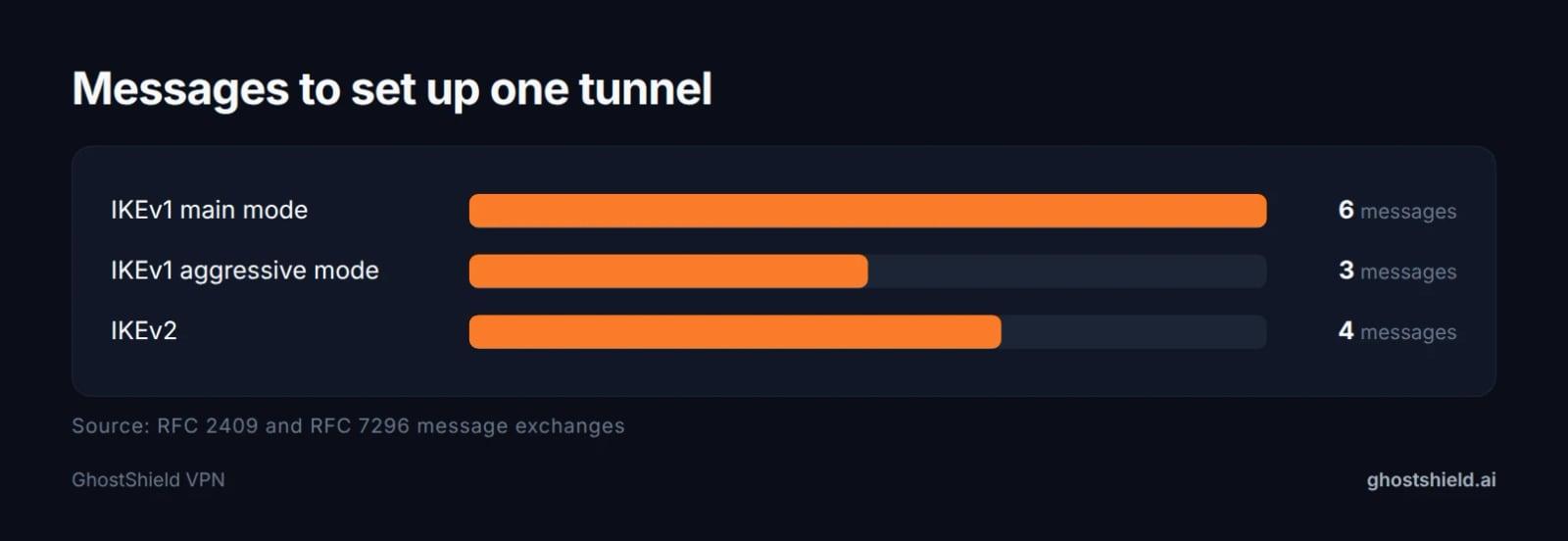 Aggressive mode looks like the fast option until you notice what it gives away.
IKEv1 main mode takes six messages to build Phase 1. IKEv2 does it in four: two in IKE_SA_INIT, two in IKE_AUTH. Aggressive mode cuts IKEv1 to three messages but sends identities in the clear, which is why admins avoid it.
Rekeying instead of re-authenticating
IKEv1 re-authenticates by tearing down the whole security association and starting again. Answers on the Cisco Learning Network describe IKEv1 re-authentication happening before the old association expires. IKEv2 rekeys the child associations inline and leaves Phase 1 alone. Remote access is also easier, because EAP is built in: username and password logins, including MS-CHAPv2, work without the XAuth workaround IKEv1 needed.
IKEv2 vs IPsec: they are not rivals
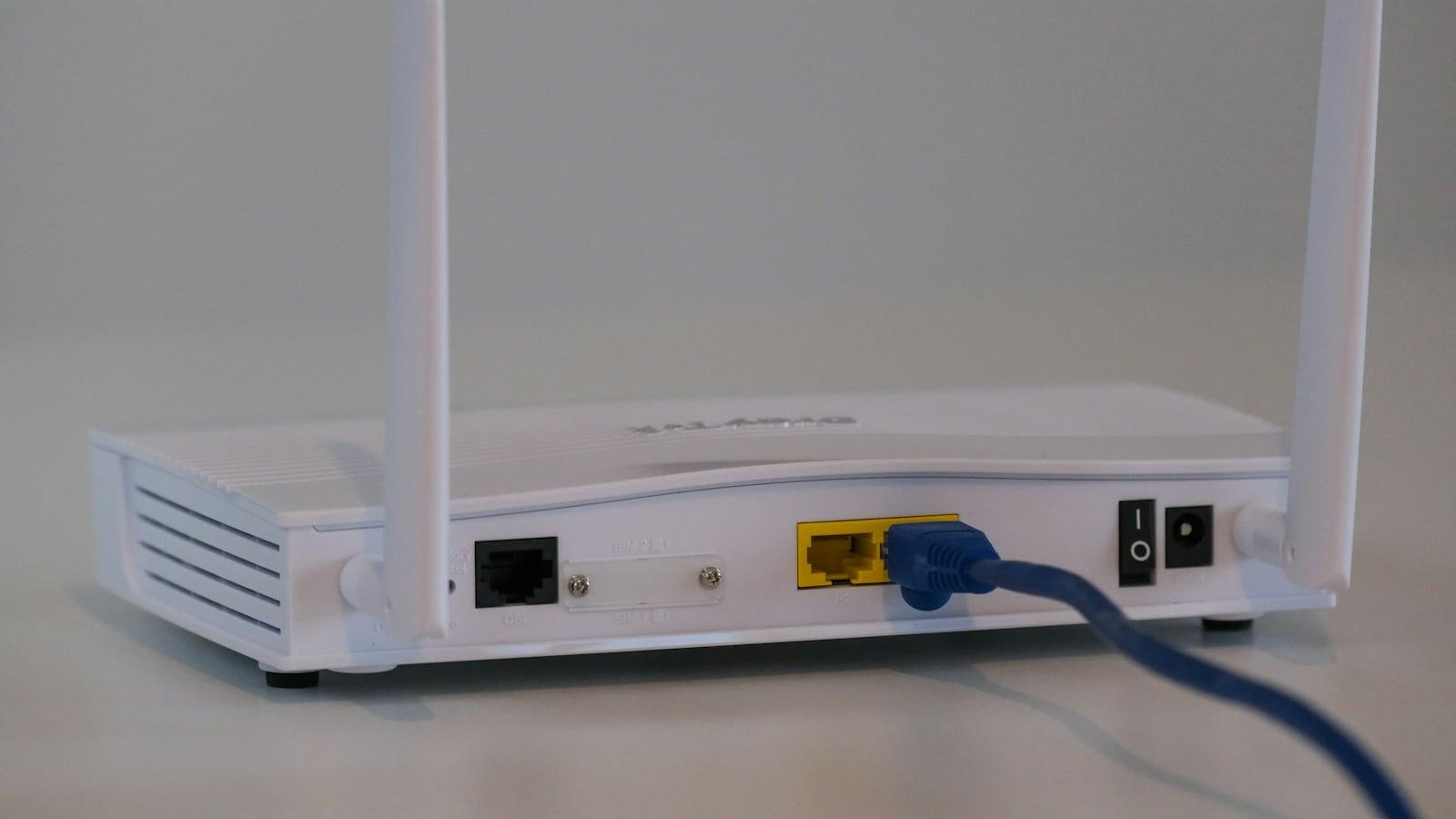
 Photo by panumas nikhomkhai on Pexels
IPsec is the data plane. It wraps your packets in ESP, encrypts them and checks their integrity. IKE is the control plane that agrees the keys and the security associations in the first place.
| Piece | What it does | Transport |
|---|---|---|
| IKE | Agrees keys and security associations | UDP 500, then UDP 4500 with NAT traversal |
| ESP | Encrypts and authenticates your packets | IP protocol 50, not a port |
| AH | Authenticates packets without encrypting them | IP protocol 51 |
ESP itself is IP protocol 50, not a port at all, which is why some hotel and office networks quietly drop it. Our post on VPN protocol ports lists the numbers side by side.
So the real question is IKEv2 vs IKEv1, both of which negotiate IPsec. Asking IKEv2 vs IPsec is like asking courier vs delivery.
IPsec Phase 1 vs Phase 2, in one minute
Phase 1 builds the IKE security association: who the two peers are, how they prove it (pre-shared key or certificate), and which algorithms they both accept.
Phase 2 builds the IPsec security association, called a child SA in IKEv2. This is the actual tunnel, one per pair of subnets or traffic selectors.
Phase 1 is longer lived and can carry several Phase 2 tunnels. In IKEv2 you can rekey a child SA without redoing Phase 1, which is the practical difference admins feel during maintenance windows.
Is IKEv1 deprecated?
 Photo by Kirill Sh on Unsplash
Not formally. IKEv1 was never withdrawn, and RFC 2409 still stands for equipment that implements it. What happened is that IKEv2 superseded it. RFC 7296 obsoletes RFC 4306 and RFC 4718 and is the version new work is built on.
Vendor documentation tells the same story. Fortinet, Palo Alto Networks, SonicWall and Cisco all still publish IKEv1 guidance alongside their IKEv2 pages, and new tunnel guidance points at IKEv2.
In practice IKEv1 hangs on in three places: firewalls that have not had a firmware update in years, ISP supplied equipment, and site-to-site links where the other organisation has not moved. If your only experience of VPNs is an app on a phone or laptop, you are unlikely to meet either version. Modern consumer apps tend to run WireGuard at this point.
Which two IKEv2 proposals should you avoid?
Vendor hardening guides land on the same two weak choices. First, Diffie-Hellman group 1 and group 2, which are 768-bit and 1024-bit MODP and well below anything current. Second, proposals built on DES, 3DES, MD5 or SHA-1 for encryption and integrity.
What to use instead: group 14 (2048-bit MODP) or higher for key exchange, AES-256 with SHA-256 or stronger for the tunnel, and perfect forward secrecy switched on. Keep the proposal list short so the peers cannot fall back to something weak. The same logic applies to IKEv1 if you are stuck with it. Removing weak proposals there is worth doing even if the version itself stays.
Where IKEv1 still forces your hand
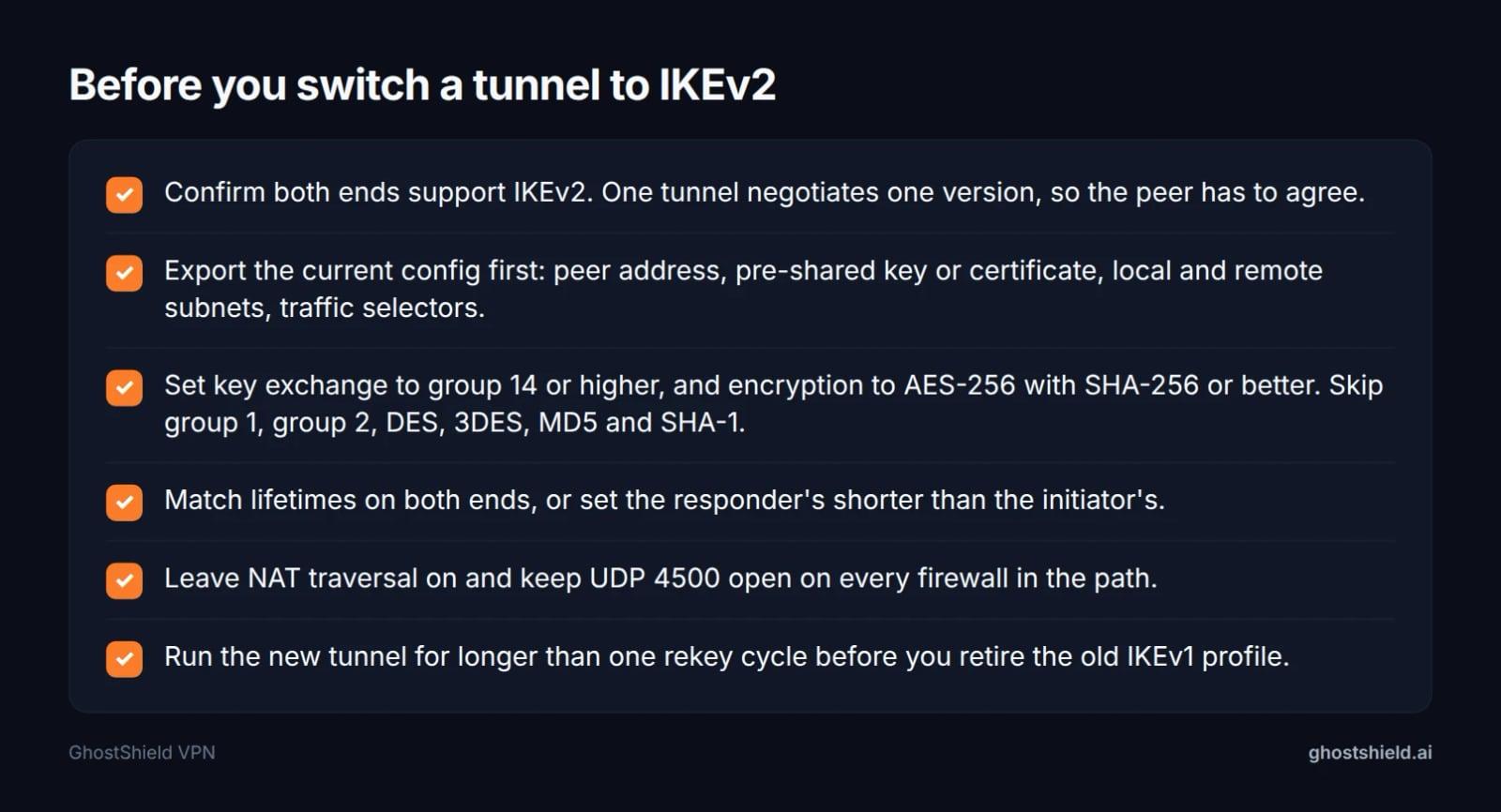 Work through these in order and the migration is usually a single maintenance window.
A single tunnel uses a single version. IKEv1 and IKEv2 do not interoperate inside one security association, so both ends have to agree. That is why a new IKEv2 config can fail against a partner's old appliance.
The usual suspects are older Cisco ASA units, small branch firewalls that were never updated, and VPN profiles that were set up years ago and never revisited.
The workaround is to run both versions side by side on the same device: keep the legacy tunnel on IKEv1 and build the new one on IKEv2. Migrate each peer when you can, not all at once.
If a tunnel refuses to come up after a change, a version mismatch is one of the first things to rule out, along with a blocked UDP 4500. If you want to see how the options stack up before you rebuild anything, compare VPN setups side by side first.
The three types of VPN, and where IKE fits
Remote access VPN: one device dials into a gateway. This is the corporate client or the phone profile, and IKEv2 is the common IPsec flavour.
Site-to-site VPN: two networks are joined by a pair of gateways. These are almost always IPsec, running IKEv1 or IKEv2 depending on the age of the hardware.
Personal or consumer VPN: an app on your device sends all its traffic to a provider's server. GhostShield VPN is this type, and it uses WireGuard rather than IPsec.
Some guides split VPNs by protocol instead, SSL against IPsec. Both splits are in use, so do not be thrown if a page you read uses the other one.
IPsec or OpenVPN? A fair comparison
IPsec with IKEv2 has one big practical advantage: it is already in the operating system. Windows, macOS, iOS and Android all ship a client, so there is nothing to install on a managed laptop.
OpenVPN is a separate application. It runs over TLS, usually on UDP 1194, and can fall back to TCP 443 when a network blocks UDP. That fallback is the reason it still has a place on restrictive networks. Our post on OpenVPN UDP vs TCP covers which to pick.
So the choice is less about which is faster and more about deployment: native client with no install, or an app you control. Our comparison of TLS VPN vs IPsec covers the same ground from the OpenVPN side.
WireGuard is the newer of the three designs and the one GhostShield VPN uses. It is UDP only, it uses ChaCha20-Poly1305, and it does not negotiate IKE versions or cipher suites at all. If you are choosing between the two modern options, Tailscale vs WireGuard explains where each fits. If throughput is your concern, run a speed test before and after any protocol change so you are comparing real numbers, not impressions.
How to check which IKE version your own gear is using
On Windows, open Settings, then Network and Internet, then VPN, and select your connection. The type reads IKEv2. There is no version switch because the built-in client speaks version 2 only.
On macOS, open System Settings, then Network, and look at the VPN entry. The type is IKEv2, again with no separate version setting.
On a firewall or router, open the IPsec or VPN page and look for an IKE version selector, often labelled IKEv1, IKEv2 or IKEv1 and IKEv2. Most current gear defaults to version 2.
On a Linux box running strongSwan, run ipsec statusall and read the version next to each connection. On a Cisco ASA, show crypto ikev2 sa lists version 2 tunnels and show crypto ikev1 sa lists version 1. If one list is empty, you know what the peer negotiated.
If two ends show different versions and the tunnel is down, you have found the cause. Switch the newer end to IKEv1 for that peer or upgrade the older one.
GhostShield VPN runs WireGuard, so there is no IKE setting to get wrong
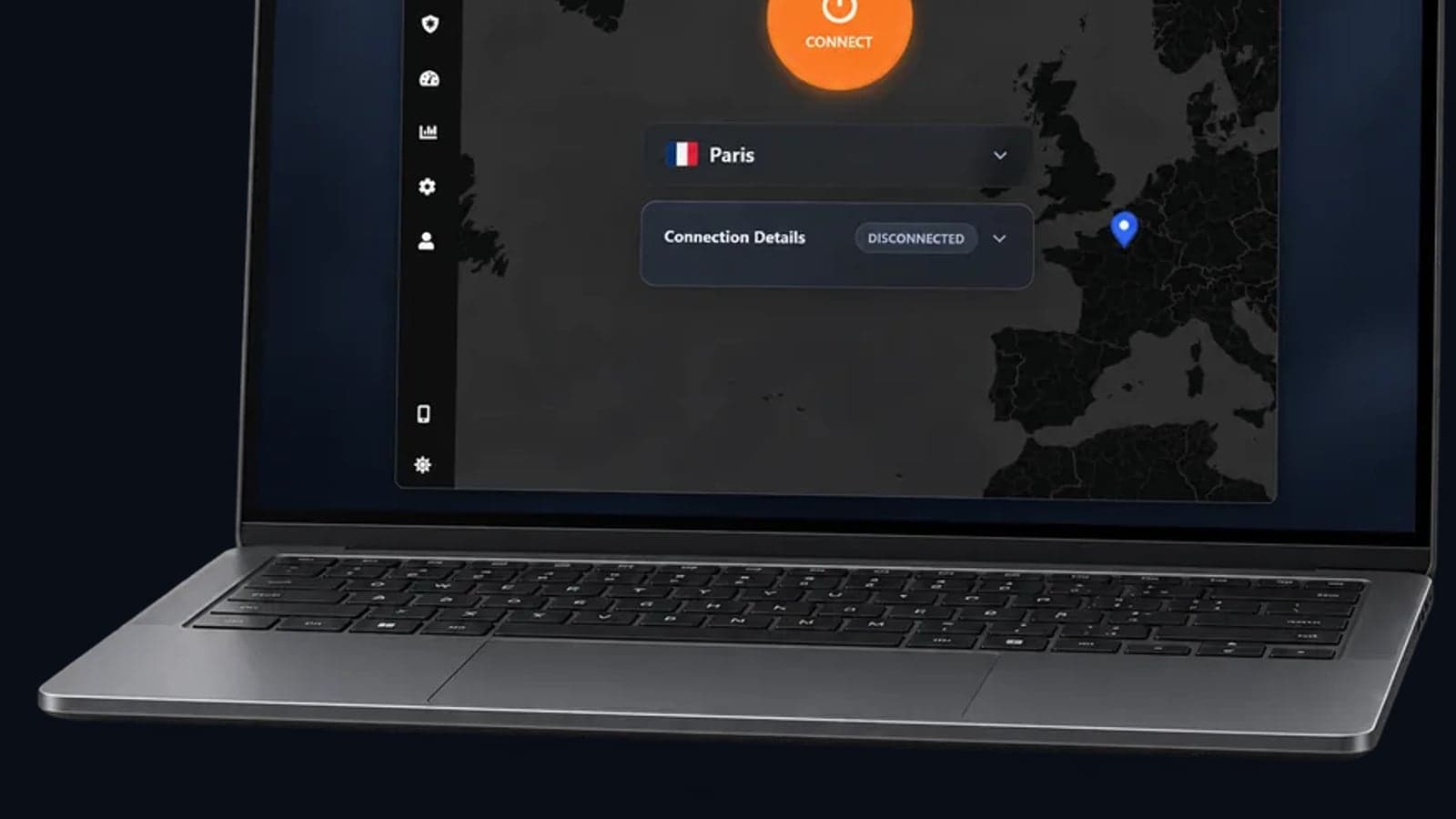
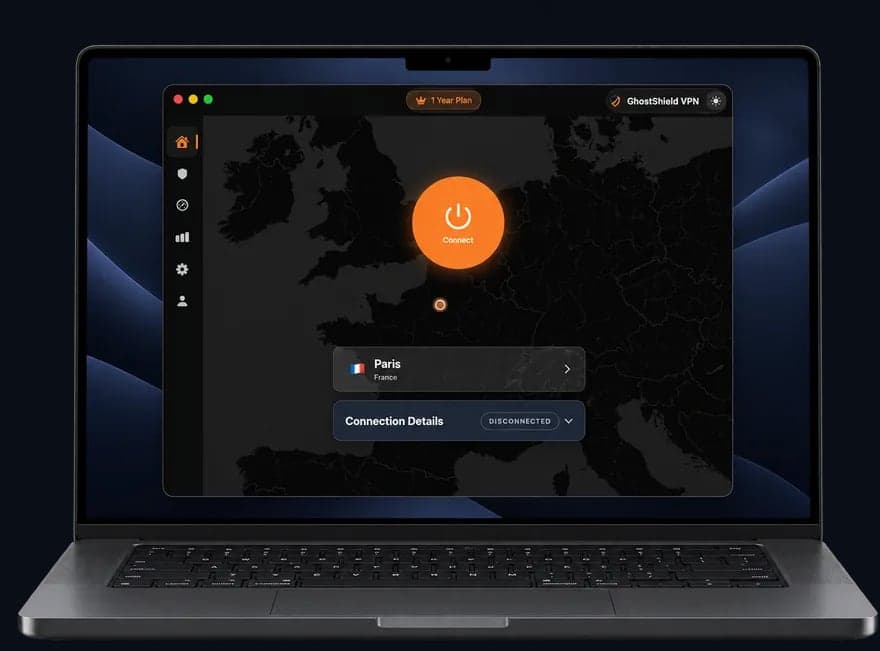 GhostShield VPN app on a MacBook
GhostShield VPN runs WireGuard with ChaCha20-Poly1305 and nothing else. No IKEv1, no IKEv2, no OpenVPN, no L2TP. There is no version to pick, no proposal to prune, no Phase 1 and Phase 2 to keep in step, and nothing to break when a peer is upgraded.
The apps cover Windows, macOS, Android, iPhone and iPad, and Google TV. Linux and routers work through a manual WireGuard configuration. You get a kill switch, DNS leak protection, split tunneling, ad and malware blocking, and 10 devices at once.
It costs $4.99 a month on the 1-year plan ($59.88 billed yearly), $3.99 a month on the 3-year plan, or $6.99 month to month. Every plan starts with a 7-day free trial, and there is a 30-day money-back guarantee.
Two limits worth knowing before you start. There is no obfuscation, so GhostShield VPN is not reliable in China, Russia, Iran or the UAE, and torrenting is not allowed. If you are travelling to one of those countries, our guide to bypassing censorship while travelling is the better starting point.
FAQ
Which is the strongest VPN to use?
There is no single strongest VPN, because it depends on what you need it to do. For a firewall tunnel, IKEv2 is the stronger key-exchange version. For an app on your phone, the protocol matters less than the provider's logging policy and how many devices you can protect with one plan.
Why avoid NordVPN?
That is not a claim we make. NordVPN is a well-known provider, and people look elsewhere for many reasons, usually cost, a feature they do not need, or a simpler app. If you are weighing a move, our guide to NordVPN alternatives sorts the options by why you are leaving.
Can IKEv1 and IKEv2 run on the same device?
Yes. One device can hold tunnels of both versions at the same time, and that is the usual way to migrate. What it cannot do is run both versions inside one tunnel, because a single security association negotiates one version and both peers must agree on it.
Does IKEv2 survive switching from Wi-Fi to mobile data?
Yes, if MOBIKE is enabled on both ends. MOBIKE lets a peer change its IP address without rebuilding the tunnel, which is why IKEv2 holds a connection through a Wi-Fi to mobile handover. Without MOBIKE support the tunnel drops and reconnects, and anything mid-transfer can fail.
What port does IKEv2 use?
IKEv2 uses UDP port 500 for the initial exchange, then UDP port 4500 once NAT traversal is detected. The encrypted payload itself is ESP, which is IP protocol 50 rather than a port. Firewalls on the path need 500 and 4500 open for the tunnel to come up.
Do I need to think about IKE if I use a VPN app?
Usually not. App based VPNs hide the negotiation, and many now run WireGuard, which has no IKE version at all. IKE only becomes your problem when you configure a firewall, a site-to-site link, or the built-in IKEv2 client on Windows or macOS.
Related Topics
Keep Reading

Best VPN Services 2026: Pick by What You Pay It For
VPN Protocol Ports: Full List and How to Test Yours

Tailscale vs WireGuard: Which Do You Actually Need?
Best VPN on a Router in 2026: An Honest Setup Guide
ExpressVPN Alternatives in 2026: Pick by Why You're Leaving