Tailscale vs WireGuard: Which Do You Actually Need?

WireGuard and Tailscale are not rivals. WireGuard is the encryption protocol that moves your packets, and Tailscale is a hosted service that runs that protocol for you, adding device discovery, sign-in and access rules. Serverside.com puts it plainly: WireGuard is the thing that encrypts and moves your packets, while Tailscale, Headscale and NetBird are control planes built on top of it. So the real question is what you are trying to do, reach your own devices or send all your traffic out through a server in another country.
If the head-to-head you want is WireGuard against OpenVPN, our WireGuard vs OpenVPN comparison covers that pair directly.
 Photo by
Which tool fits your job?
Three jobs get mixed up in this search, and the table below lets you stop reading as soon as your row appears.
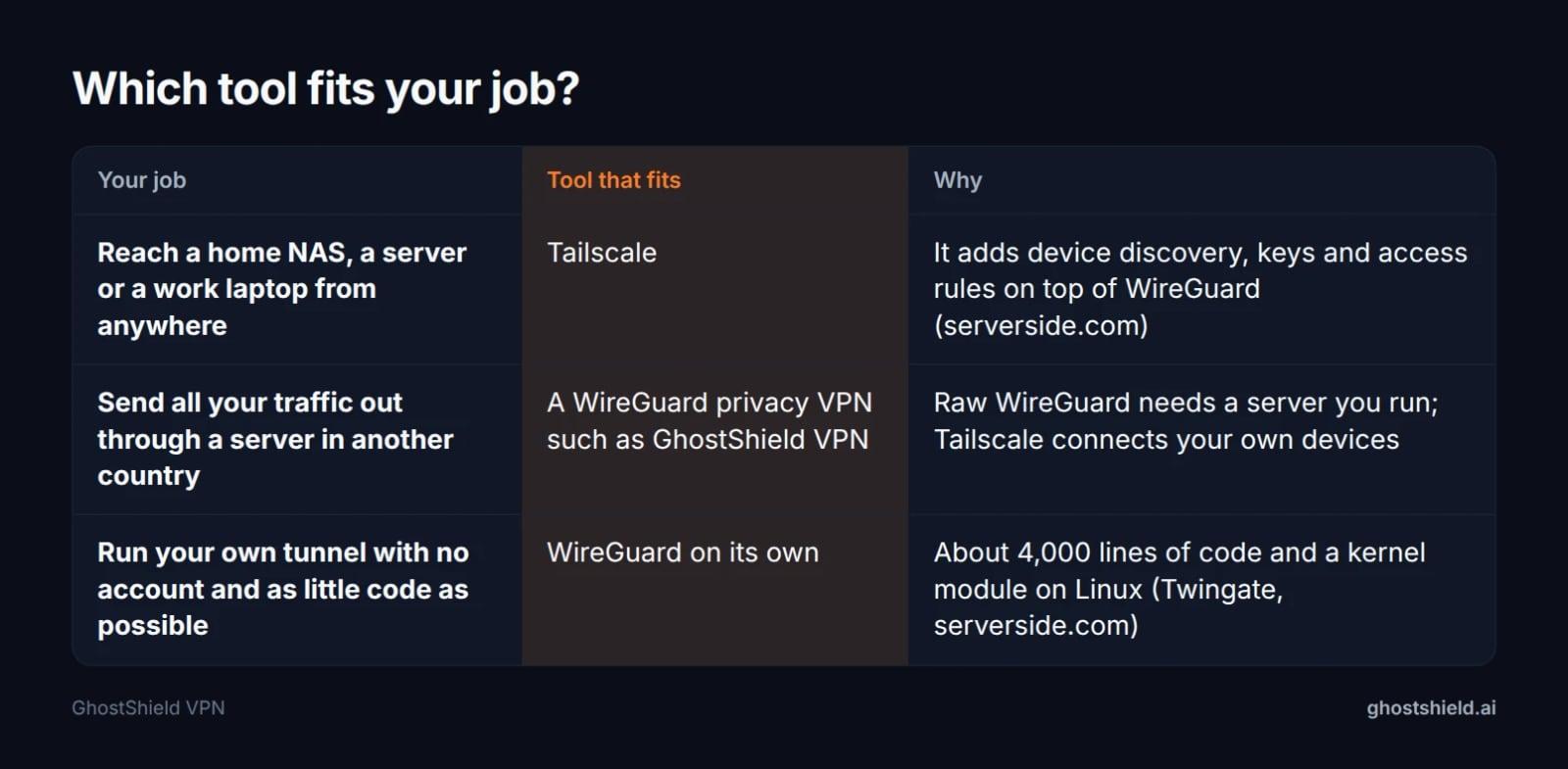 Start with the job, not the product name.
WireGuard, Tailscale and a privacy VPN solve three different problems
Row one is the homelab and remote work case. You want the files on your home NAS or a shell on the office desktop while you sit in a cafe. Tailscale adds device discovery, key handling and access rules on top of WireGuard (serverside.com).
Row two is the privacy case. You want your traffic to leave from another country, which needs an exit server you do not own. Raw WireGuard gives you the tunnel, not the server.
Row three is the tinkerer case. A personal tunnel with no account, built from a protocol of about 4,000 lines of code (Twingate, serverside.com).
None of these replaces the others. If your question was which one hides your IP, the answer is neither on its own. Tailscale connects devices you already own, and raw WireGuard connects two machines you control. GhostShield VPN is the fit for the browsing job, and the VPN comparisons hub covers the rest.
What WireGuard and Tailscale actually are
WireGuard is the protocol
WireGuard encrypts and moves packets between two peers. It is a protocol, not an app you sign into, and there is no company behind it to bill you. On Linux it runs inside the kernel from version 5.6 onward (serverside.com), which matters in the next section. Twingate describes it as modern, simple, fast and secure, and notes the implementation is only about 4,000 lines of code.
Tailscale is the control layer on top
Tailscale handles device discovery, key distribution, user identity and access rules, then lets the devices talk over WireGuard. dev.to puts it the same way: connections use WireGuard, while Tailscale manages users and discovery. The coordination server is closed source and hosted by Tailscale. Headscale is the self-hosted version of the same idea, and NetBird is an open alternative (serverside.com).
The practical difference is who does the tedious parts. With WireGuard alone you run the server, exchange keys and write firewall rules. With Tailscale you sign in and the devices appear. If you are still settling on a protocol for a work setup, our posts on TLS VPN vs IPsec and OpenVPN UDP vs TCP go deeper.
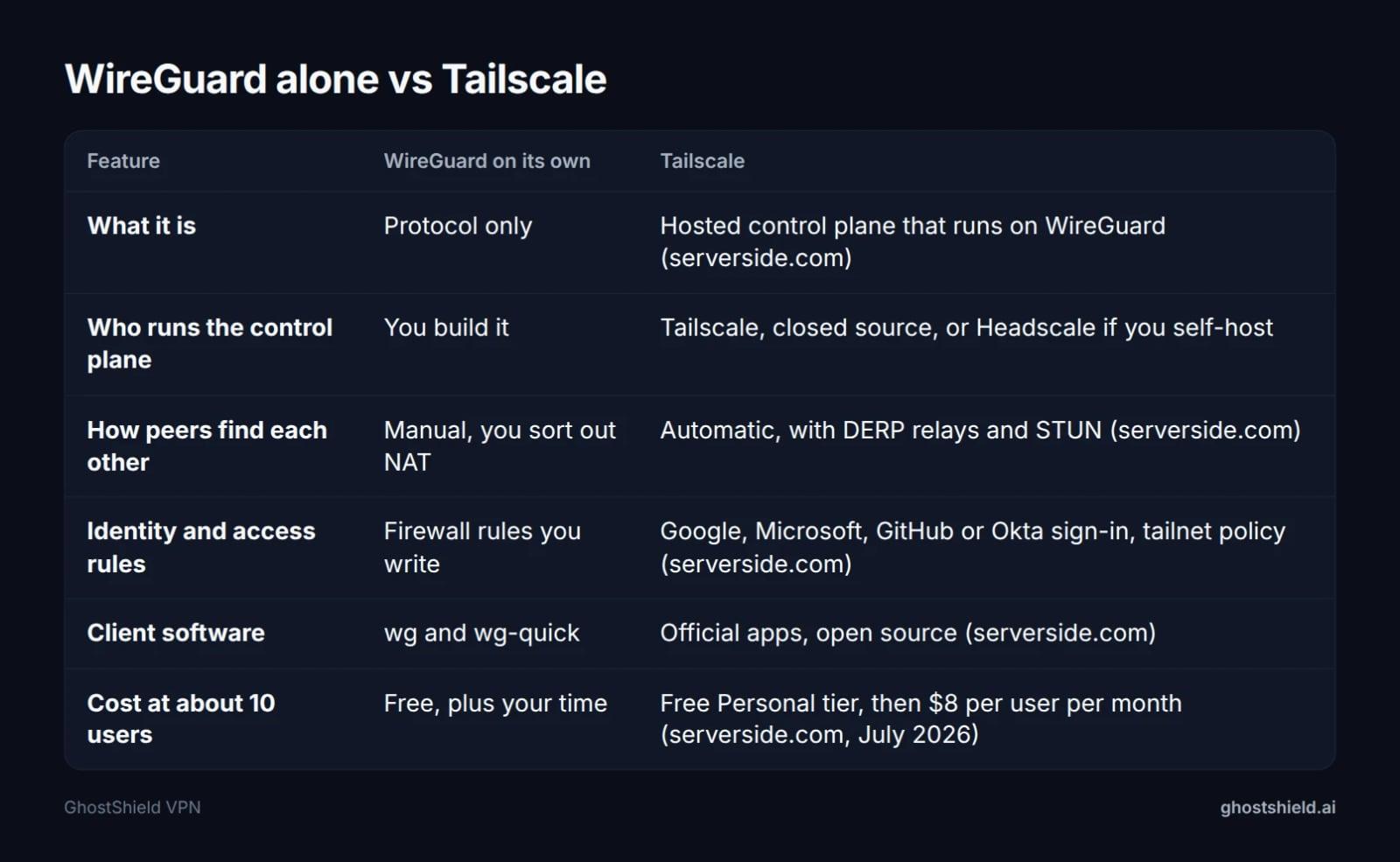 WireGuard is the data plane. Tailscale is the control plane you rent or host yourself.
Speed: kernel, userspace and relays
Everyone repeats that both use WireGuard, so throughput must be identical. That is true of the protocol and false in practice, for two reasons: kernel versus userspace, and direct versus relayed.
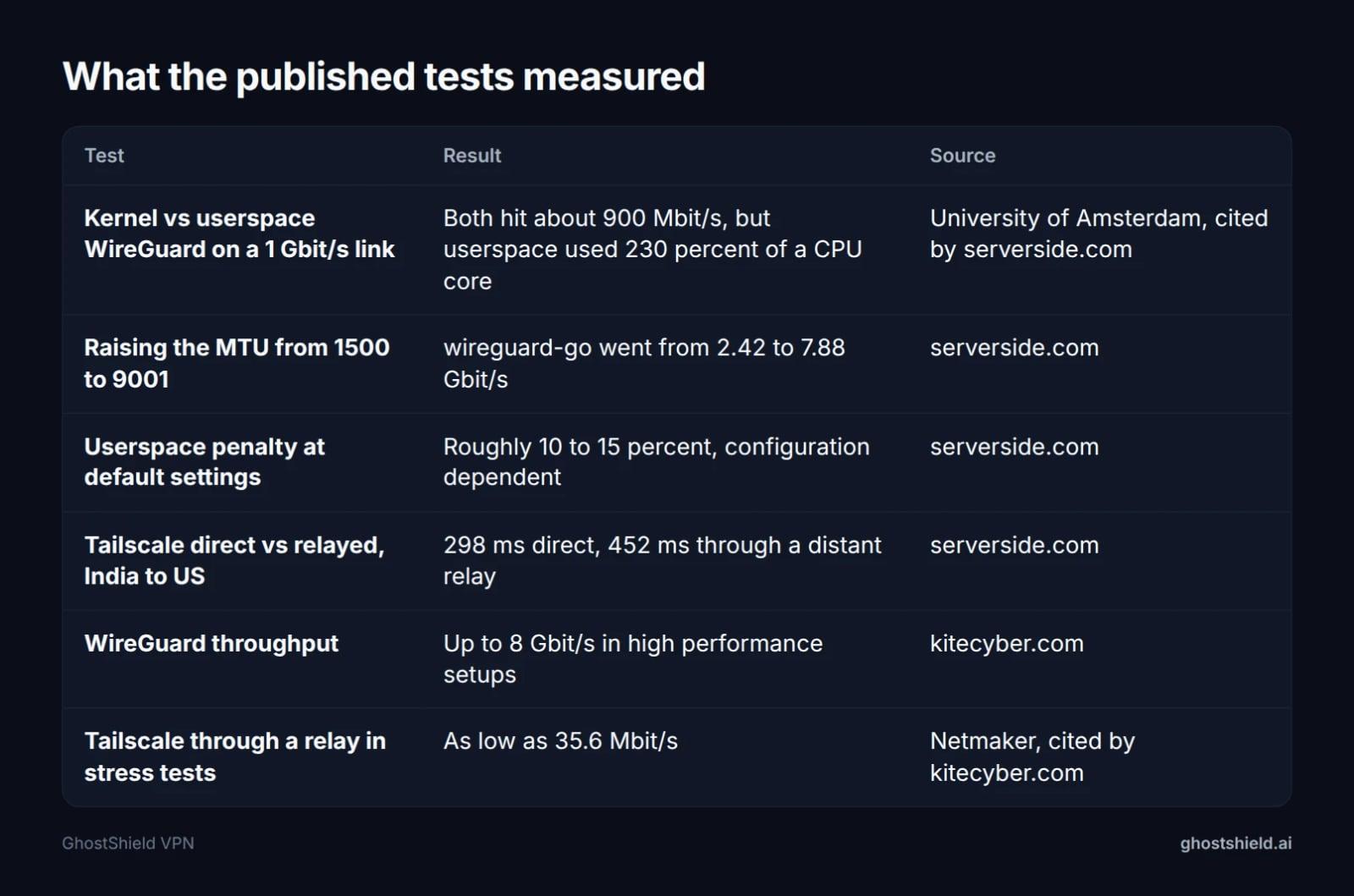 Published numbers, and what each one actually measured.
In a University of Amsterdam study over a 1 Gbit/s link, kernel WireGuard and userspace wireguard-go both saturated the link at about 900 Mbit/s, but wireguard-go burned 230 percent of a CPU core while the kernel module stayed under one (serverside.com). The same source reports that raising the MTU from 1500 to 9001 alone moved wireguard-go from 2.42 to 7.88 Gbit/s. A misconfigured overlay MTU costs more throughput than the kernel gap does. The familiar rule of thumb, a 10 to 15 percent userspace penalty at default settings, is directionally right but depends on configuration (serverside.com).
Relays are the bigger variable. In one Tailscale case study on an India to US path, a distant relay measured 452 ms against 298 ms for a closer near-direct path (serverside.com). kitecyber.com reports WireGuard reaching up to 8 Gbit/s, Tailscale passing 10 Gbit/s on Linux with UDP segmentation, and Tailscale dropping to as low as 35.6 Mbit/s in relay stress tests, citing Netmaker.
The takeaway: if your two peers can open a direct connection, both are fast. If a relay gets involved, latency follows the distance to the relay.
Setup, accounts and cost
WireGuard alone means generating a key pair per device, pasting public keys on both ends, writing an interface config, opening the UDP port and handling NAT yourself. kitecyber.com sums the trade-off up as manual configuration and a CLI-based interface, with no SSO.
Tailscale means signing in with Google, Microsoft, GitHub or Okta, installing the client, and letting the devices join your tailnet. Access rules live in a policy file rather than in firewall rules you hand-write.
 Photo by Roberto Hund on Pexels
| Option | What you pay | What to know |
|---|---|---|
| WireGuard on your own server | Free software, plus the server bill and your time | You run keys, NAT and firewall rules |
| Tailscale Personal | Free, 6 users and unlimited devices (serverside.com, July 2026) | A hosted control plane does the discovery |
| Tailscale Standard | $8 per user, per month (serverside.com, July 2026) | Priced per seat |
| Tailscale Premium | $18 per user, per month (serverside.com, July 2026) | Priced per seat |
Prices move, so check the vendor page before you commit. For a solo homelab the free tier usually covers it. For a small team, the per-seat price is the line item to watch.
One caution worth keeping in view: a mesh tool is a networking product, not a privacy purchase, so do not judge it on whether it hides your browsing.
Can you run WireGuard and Tailscale at the same time?
Usually yes, but the details decide it. Two tunnels that both claim the default route will fight, and one of them loses.
 Photo by Brett Sayles on Pexels
Tailscale normally carries only traffic to your own devices, so ordinary browsing still leaves from your normal connection and a second full-tunnel VPN can sit alongside it. Conflicts show up when you add subnet routes or send all traffic through one machine in the tailnet, because then both tools want every packet.
Test it rather than guess. Connect both, open the what is my IP tool and see which address the outside world gets. A DNS leak test shows whether queries are escaping the tunnel you expected.
GhostShield VPN has split tunneling, which lets you choose which apps go through the tunnel and which keep their normal route. That is the cleanest way to stop a device to device mesh and a privacy tunnel from stepping on each other. If this is a work laptop with both tools installed, read stay safe while working remotely first.
When the job is hiding your IP, a mesh is not the tool
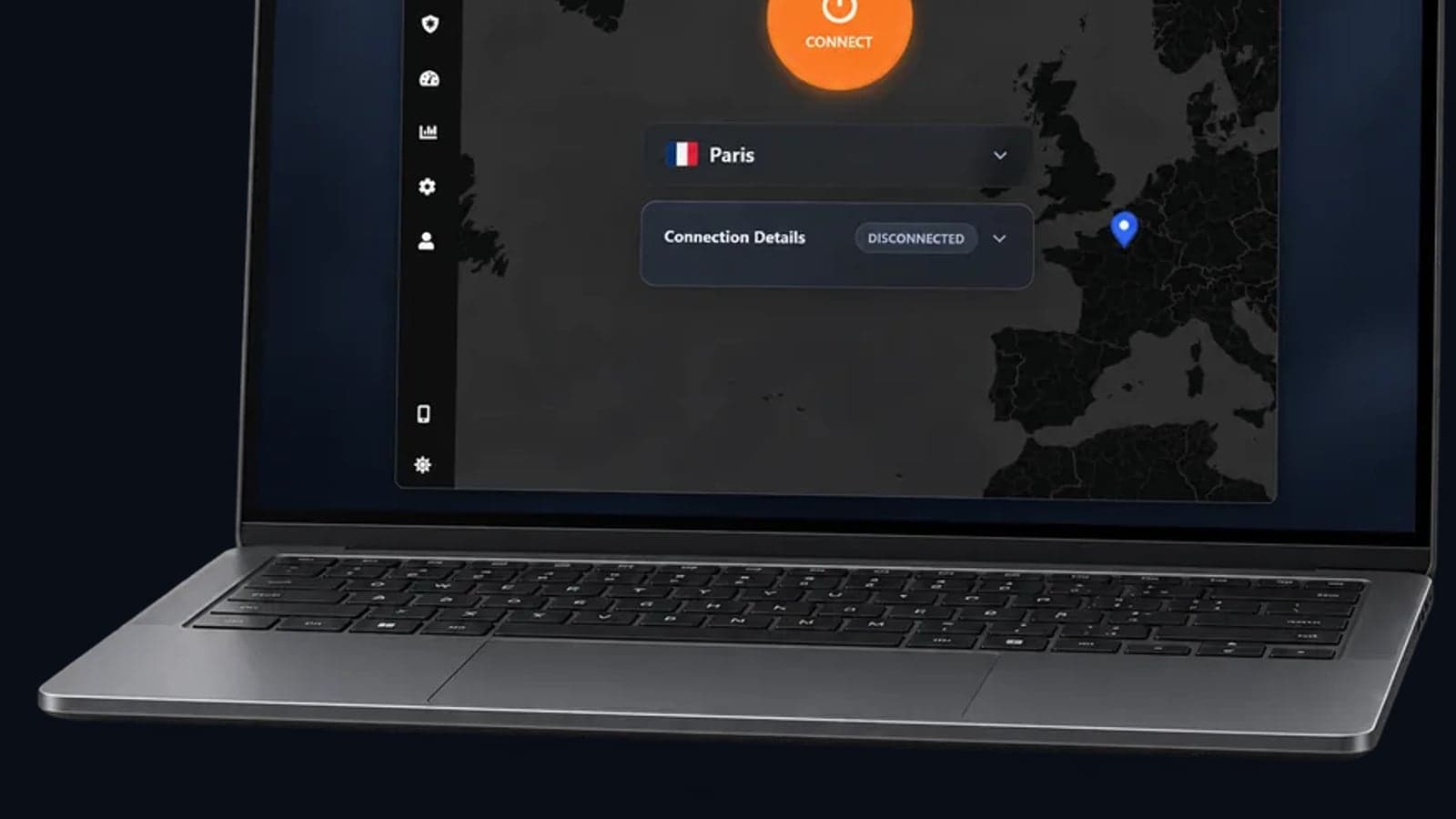
GhostShield VPN is a privacy VPN, not a mesh. It runs WireGuard with ChaCha20-Poly1305 and nothing else, on servers in 16 countries across 20 locations.
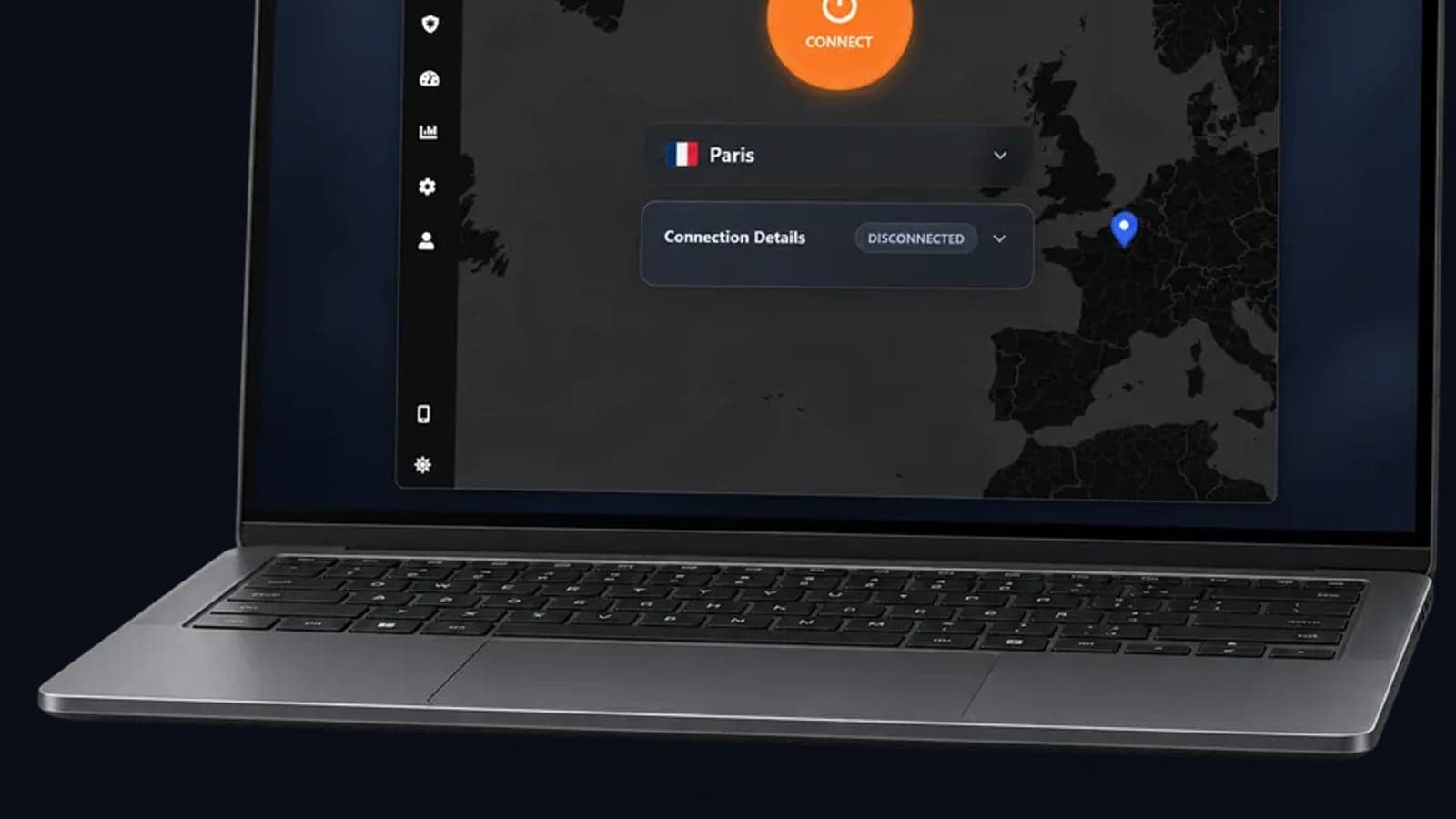
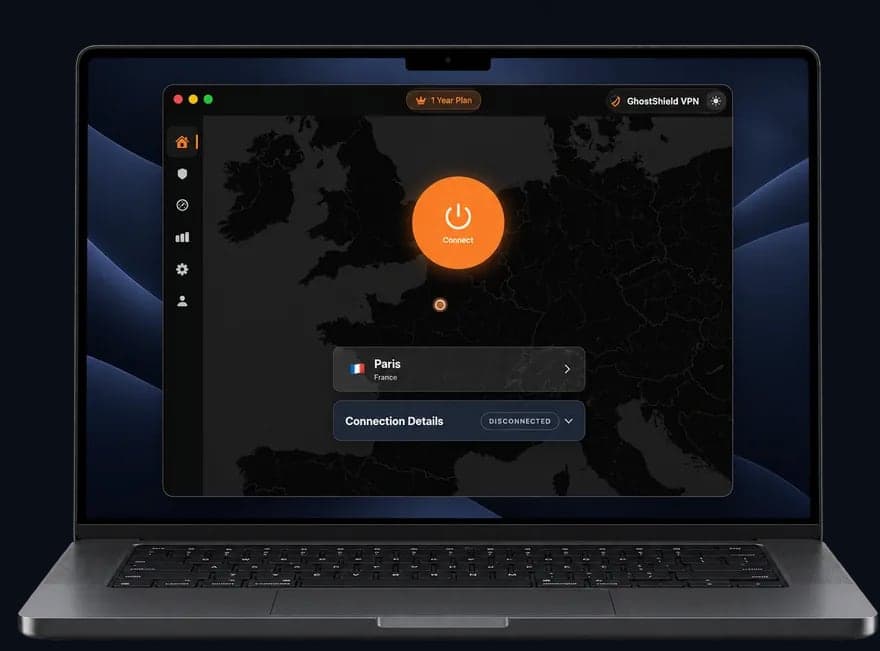 GhostShield VPN app on a MacBook
A plan covers 10 devices at once, with apps for Windows, macOS, Android, iPhone, iPad and Google TV. Linux and routers connect through a manual WireGuard configuration. If you are buying for one machine, our macOS checks before you buy a VPN, iPhone VPN checklist and Android VPN software posts cover the details.
You get the kill switch, DNS leak protection, split tunneling, ad and malware blocking, family mode and AI threat detection. There is no dedicated IP, no port forwarding, no double VPN and no Smart DNS.
Be plain about the boundary. GhostShield VPN does not replace Tailscale or a home WireGuard server for reaching your own NAS. If that is your goal, use those instead.
There is no obfuscation, so GhostShield VPN is not reliable in China, Russia, Iran or the UAE. If you are in one of those countries, read the country VPN guides before you buy.
Every plan starts with a 7-day free trial and carries a 30-day money-back guarantee. The 1-year plan is $4.99 a month, billed at $59.88 a year, and the 3-year plan is $3.99 a month, billed at $143.64. See GhostShield VPN pricing for the current options.
The no-logs policy is strict: nothing passing through the tunnel is stored, so no browsing activity, no traffic content, no DNS queries and no real IP addresses. No third-party audit of GhostShield VPN has been completed yet, and that is worth knowing before you sign up. Our guide on how to check a no-logs claim explains what to look for in any provider.
WireGuard on its own: what it does not do
Does WireGuard hide your IP? Not by itself. A tunnel hides your address from a site only when the tunnel ends somewhere else and your traffic exits there. Point a WireGuard tunnel at your own home server and websites still see your home connection.
Is WireGuard the same as OpenVPN? No. They are different protocols. OpenVPN is older and built on TLS, while WireGuard is newer with a far smaller codebase. Twingate's 4,000 line figure is the one people quote.
The disadvantages of WireGuard, as the comparisons list them: manual key exchange and configuration, manual NAT traversal, no built-in identity or SSO, a CLI-first experience, and a userspace CPU cost where the kernel module is unavailable. It also has no obfuscation layer, which is why it struggles on networks that block VPN traffic outright.
None of this makes it a bad protocol. It makes it a building block, and building blocks need a control layer or a provider to be useful to most people.
Changing or masking your IP without a VPN
Can I change my IP address without using a VPN? Yes, in several ordinary ways: restart the router and wait for a new dynamic lease, toggle airplane mode on a phone, join another Wi-Fi network, or ask your ISP for a new address.
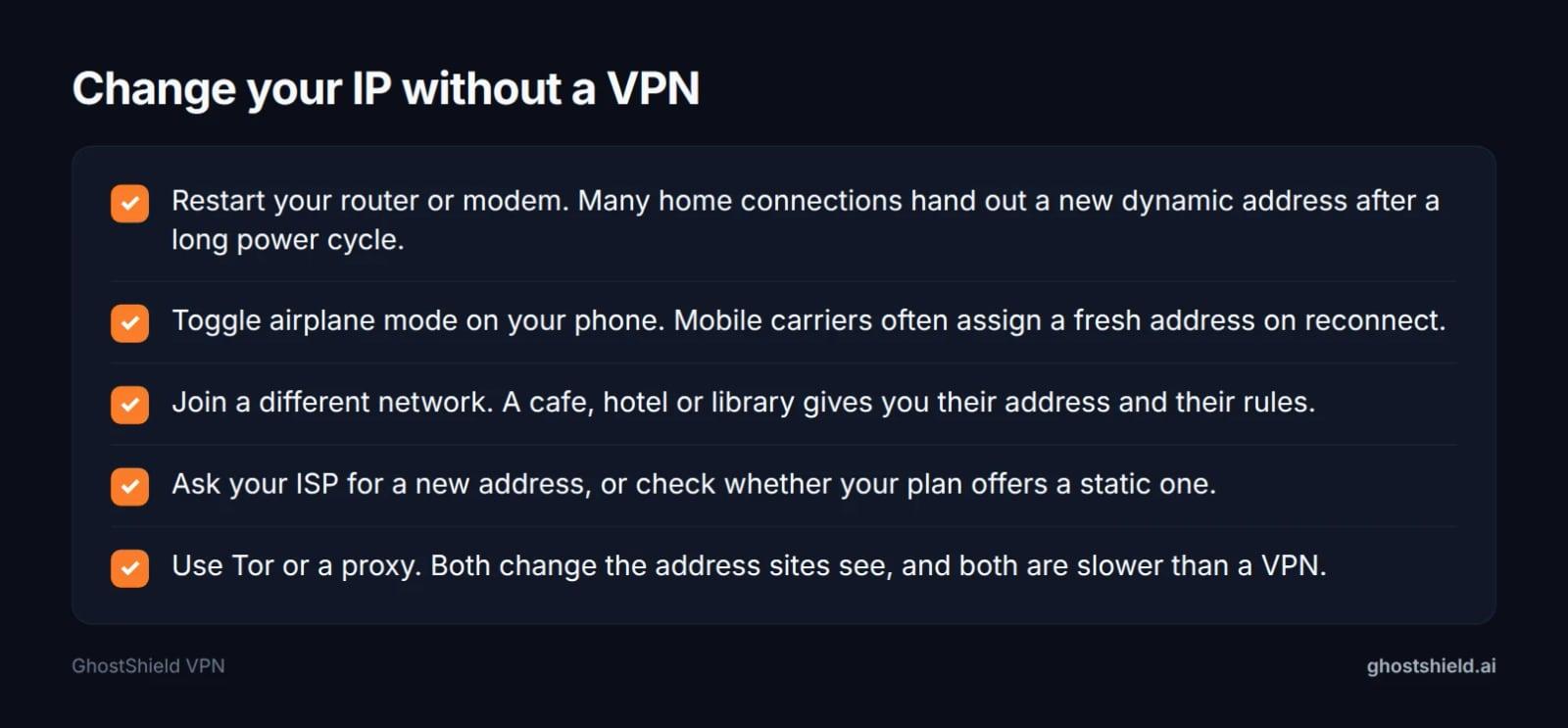 Five ways to get a different IP, and what each one does not hide.
Each one has a catch. Your new address is still yours, still tied to your city and provider, and a site that blocked you can often recognise you again.
Is changing your IP illegal? No, not in itself. Changing your own address is a normal part of networking. Legality turns on what you do next: fraud, dodging a ban, evading a court order or reaching someone else's account are separate problems, and rules differ by country.
How do I mask my IP without a VPN? A proxy or the Tor browser will do it. Both add latency, and a proxy operator can see the traffic you send through it.
Can the FBI track a VPN? A VPN hides your address from websites. It does not hide you from account records, device data, payment trails or a lawful request to the provider. That is exactly why the logging policy is the thing to check before you buy.
Rules on VPN use also vary by country, and a few places restrict it, so read the country VPN guides rather than assuming one answer fits everywhere.
FAQ
Can I run WireGuard and Tailscale at the same time?
Yes, usually. Tailscale normally carries only traffic to your own devices, so a full-tunnel VPN can run alongside it. Problems start when both want every packet, for example with subnet routes or an exit node. Connect both, then check which address the outside world sees with an IP lookup tool.
Is Tailscale a good VPN provider?
It is good at what it does, but it is not a browsing VPN. Tailscale connects your own devices into a private network and handles sign-in, keys and access rules. It does not send your traffic out through a server in another country, so it will not change the address websites see.
Does WireGuard hide your IP?
Not by itself. WireGuard builds an encrypted tunnel, and your address is hidden only if the traffic exits somewhere else. Point a tunnel at your own home server and websites still see your home connection. You need a remote exit server, normally a VPN provider, for that.
What are the disadvantages of WireGuard?
WireGuard leaves the hard parts to you: manual key exchange, manual NAT traversal, no built-in identity or single sign-on, and a command line first experience. It also adds CPU cost where the kernel module is unavailable, and it has no obfuscation, so networks that block VPN traffic can still stop it.
Is changing my IP address illegal?
No, changing your own IP address is not illegal in itself. Restarting a router or joining another network is ordinary networking. What you do next is what the law looks at, and rules vary by country, so fraud, dodging a ban or evading a court order remain separate matters.
Can the FBI track a VPN?
Partly. A VPN hides your address from the websites you visit, but not from account records, device data, payment trails or a lawful request to the provider. Whether the provider has anything to hand over depends on its logging policy, which is the thing to check before you buy.
Can I change my IP address without using a VPN?
Yes. Restart the router and wait for a new dynamic lease, toggle airplane mode on a phone, join another network, or ask your ISP for a new address. Each gives you a different address, but it is still tied to your city and provider.
How do I mask my IP address without a VPN?
Use a proxy or the Tor browser. Both change the address a site sees, and both add latency. A proxy operator can also see the traffic you send through it, which an encrypted tunnel would hide. Neither is a full substitute for a tunnel you trust.
Is WireGuard the same as OpenVPN?
No, they are different protocols. OpenVPN is older and built on TLS. WireGuard is newer with a much smaller codebase, about 4,000 lines according to Twingate. They solve the same basic job in different ways, and the setup work differs more than the encryption does.
Related Topics
Keep Reading

Best VPN Services 2026: Pick by What You Pay It For
VPN Protocol Ports: Full List and How to Test Yours
Best VPN on a Router in 2026: An Honest Setup Guide
ExpressVPN Alternatives in 2026: Pick by Why You're Leaving
VPN Best Paid in 2026: What $3 to $15 a Month Buys You