OpenVPN vs Tailscale: Which One Fits Your Job? (2026)
OpenVPN is a protocol you run on a server you control. Tailscale is a service that connects your own devices into one private network. Both encrypt traffic between machines, which is why they share a search, but they do different jobs: OpenVPN gives you a server to run, Tailscale gives you a private network without the server work.
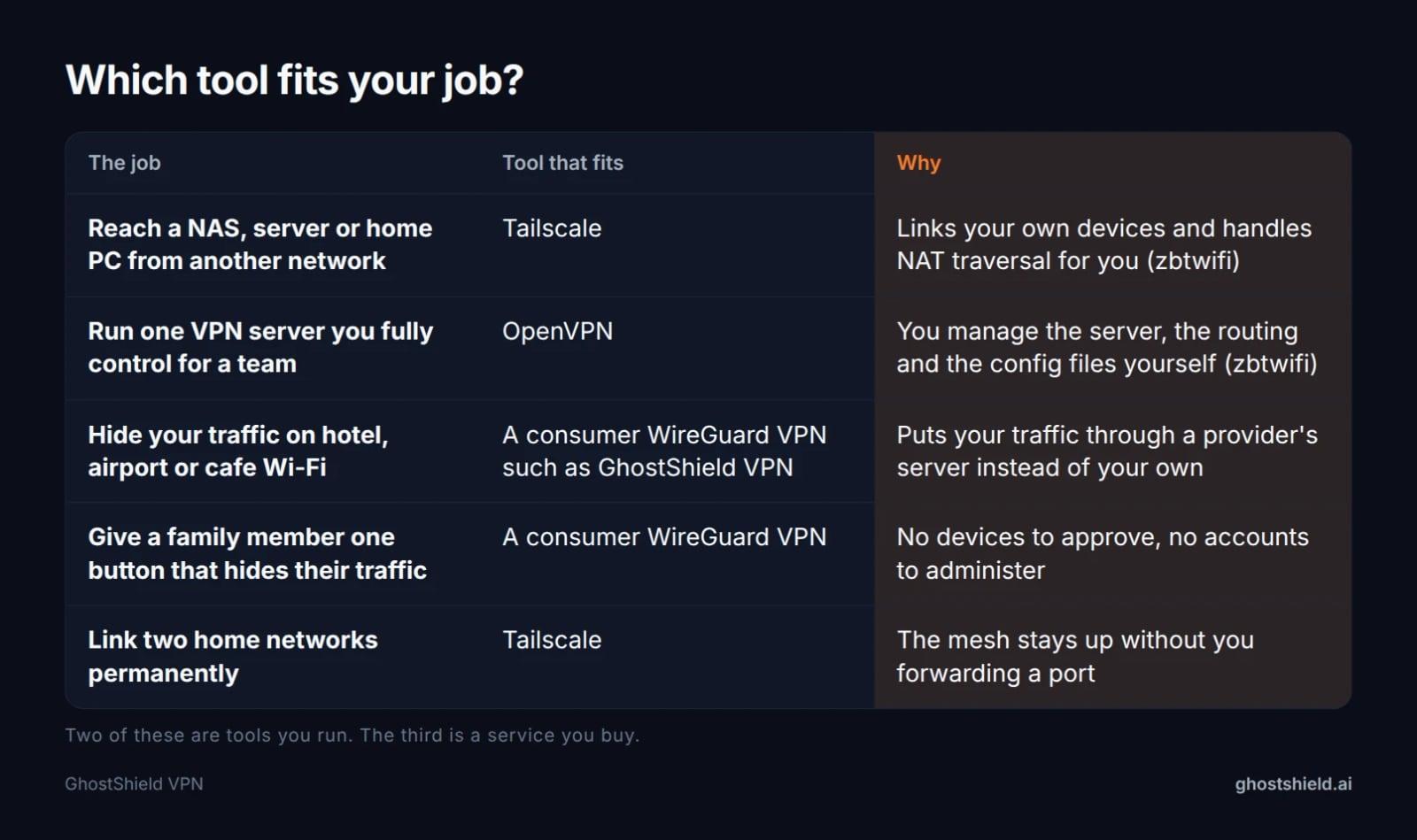 Pick by the job you actually have, not by which name you heard first.
That is the short version. The rest of this page explains why each tool lands where it does, and where each one stops.
What OpenVPN and Tailscale actually are
These two names sit in the same search because both encrypt traffic between two machines. As zbtwifi puts it, OpenVPN and WireGuard are VPN protocols, whereas Tailscale is a networking service built on WireGuard's foundation.
OpenVPN is a protocol you run
OpenVPN dates to 2001, and zbtwifi calls it one of the most established protocols, with clients for Windows, macOS, Linux, Android and iOS. You install a client and point it at a server: one you built, one your employer runs, or one you rent. The certificates, the routing and the firewall rules are yours to set up and yours to keep running.
Tailscale is a service built on WireGuard
The same guide describes Tailscale as using WireGuard as its backbone and adding automation on top, including NAT traversal and address management. You install the client, sign in, and your devices find each other. There is no server to build and no port to forward. The coordination layer runs as a service rather than on a machine you maintain.
OpenVPN encryption and WireGuard's speed
zbtwifi lists AES and ChaCha20 among OpenVPN's encryption options, part of why it has lasted so long. WireGuard, in the same guide, is designed for speed and efficiency, uses ChaCha20, and keeps its codebase to about 4,000 lines, which makes it simple to maintain and quick on high-bandwidth work such as streaming or gaming. Tailscale uses that WireGuard backbone and adds a management layer, so it inherits the speed and the cipher.
OpenVPN vs Tailscale, side by side
The table below is drawn from the zbtwifi guide and the stackshare.io comparison, with the r/homelab thread at the top of this search as the worked example. stackshare.io lists ease of use, networking infrastructure, accessibility and scalability as the main differences, and each column here maps to one of them.
| OpenVPN | Tailscale | |
|---|---|---|
| What it is | A VPN protocol you run on a server | A networking service built on WireGuard that links your own devices |
| Who runs the network | You, or your employer: the server, the keys and the routing | Tailscale runs the coordination layer; you own and manage the devices |
| Setup | Install a client, point it at your server, manage certificates, routing and firewall rules | Install the client, sign in, and the devices find each other |
| NAT traversal | You need a server the client can reach, usually a public IP or port forwarding | Handled for you, with no port forwarding or dynamic DNS |
| Best for | One server you fully control, with full routing control for a team | Reaching a NAS, home PC or another device across networks |
The r/homelab thread is the pattern in practice: a Synology NAS acting as an OpenVPN server so it can be reached from outside. OpenVPN gives you control and charges you in setup time. Tailscale gives you convenience and takes the network out of your hands. OpenVPN that you run yourself gives you control, not anonymity, and Tailscale links your own devices; putting all of your traffic through a server you do not run is a separate job, and it gets its own section below.
Is OpenVPN obsolete in 2026?
No. It is still maintained, and zbtwifi lists clients for Windows, macOS, Linux, Android and iOS, so it runs on nearly every major platform. What has changed is the default: WireGuard arrived in 2020 and most new setups start there. OpenVPN still earns its place when you want one server, one config file and full control of routing, which is why it has not gone anywhere.
If you are tuning an existing OpenVPN server, the choice between UDP and TCP will move your speed more than the protocol debate does. We covered that in UDP versus TCP for OpenVPN.
Why people use Tailscale instead of a VPN
Because the job is different. A traditional VPN puts your traffic through a server. Tailscale connects your own devices to each other, and those are not the same thing.
The r/homelab thread on page one is the usual case: a Synology NAS at home, a laptop somewhere else, and no wish to expose the NAS to the open internet. zbtwifi lists what that saves you: no port forwarding, no dynamic DNS, no manual setup. It is also why the related searches mention Home Assistant and ZeroTier: same problem, a box in the spare room you want to reach from a phone on mobile data.
For the protocol question underneath, our Tailscale vs WireGuard comparison picks up where this one stops.
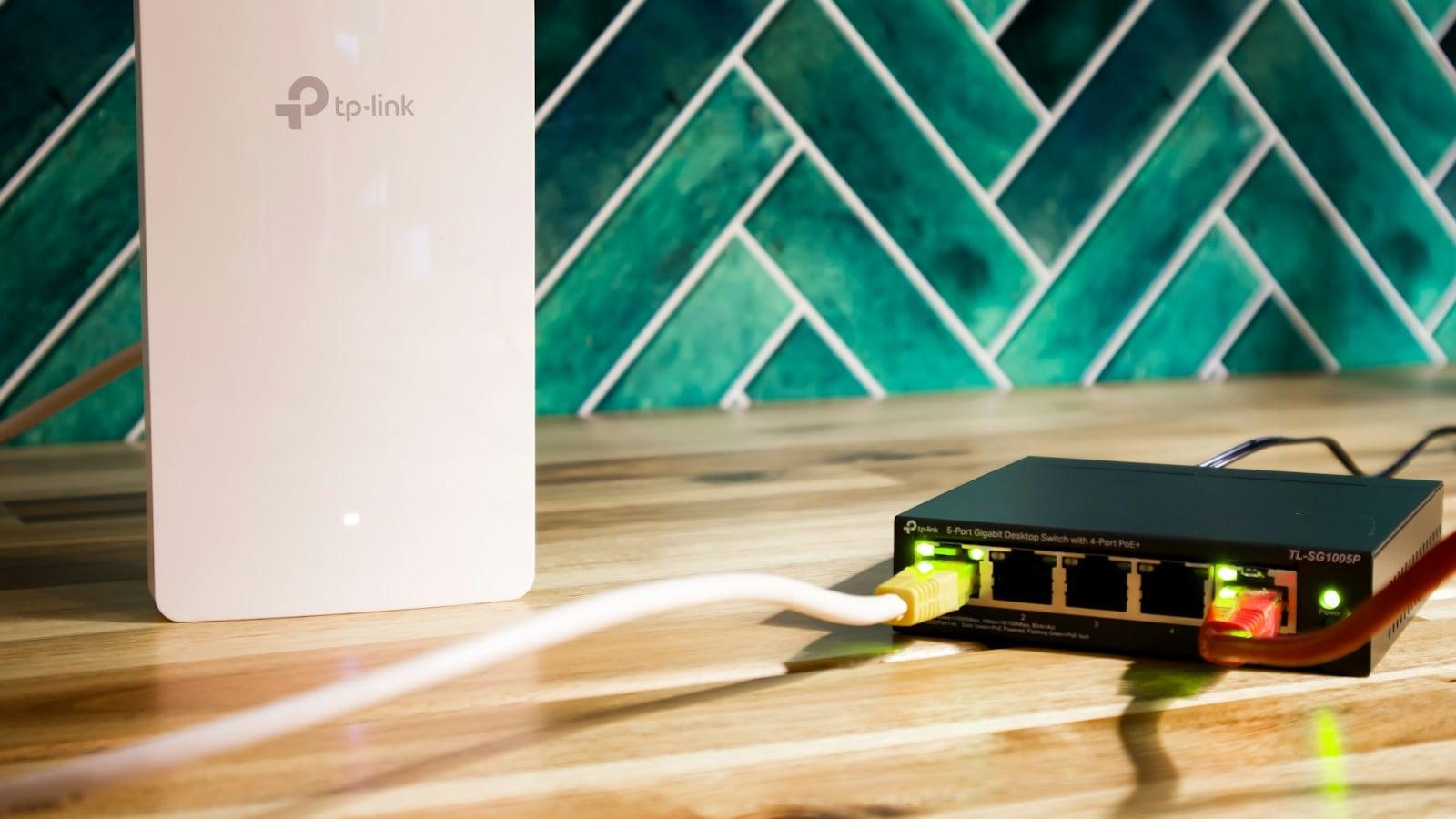
 Photo by Brett Sayles on Pexels
The downsides of Tailscale
It is a service, not only a program. Your devices find each other through Tailscale's coordination layer, so a company holds the map of your network even though the traffic itself is encrypted.
It solves reachability, not anonymity. Joining hotel Wi-Fi with Tailscale running does not change what that network sees when you browse.
Distance still costs you. Two devices on opposite sides of the world talk across that distance, so speed depends on the route between them rather than on a server near you.
Admin work does not vanish, it moves. You manage devices and who can reach them instead of managing certificates and firewall rules.
None of these are faults. They are the trade you accept for the setup that Tailscale removes.
Is Tailscale a safe VPN?
The encryption is real. zbtwifi describes Tailscale as WireGuard underneath, so traffic between your devices is protected by WireGuard's ChaCha20 cipher.
Safe and private are different questions. Tailscale is built to connect devices you own; it is not built to make your browsing unlinkable to you. So the answer depends on what you are protecting. A NAS from the open internet, yes. Your identity from a network you do not trust, no.
Is it safe to leave Tailscale on all the time?
Leaving it on keeps your devices reachable to your tailnet, which is the whole point of installing it. The risk is who else is in that tailnet. Review the device list every few months and remove hardware you no longer use. A lost phone that still holds a key is the real problem, not the app running.
If you are weighing it against a consumer VPN, our roundup of the Best VPN Services 2026 sorts the options by what you actually pay for.
Hiding your traffic on a network you do not trust
GhostShield VPN is a consumer WireGuard VPN, and it covers the third job in the table. There are no OpenVPN config files to import and no mesh networking, so it will not join your laptop to your home NAS. That limit is worth saying plainly before a trial starts, because it is exactly what some readers of this search are hoping for.
What it does is run your traffic through servers in 16 countries (20 locations), on Windows, macOS, Android, iPhone, iPad and Google TV, with a kill switch, DNS leak protection, split tunneling, and ad and malware blocking.
Linux and routers work through a manual WireGuard configuration. There is no browser extension and no console app.
Readers in China, Russia, Iran or the UAE should know that there is no obfuscation, so this is not a service built for those networks.
Set up GhostShield VPN before you join the network
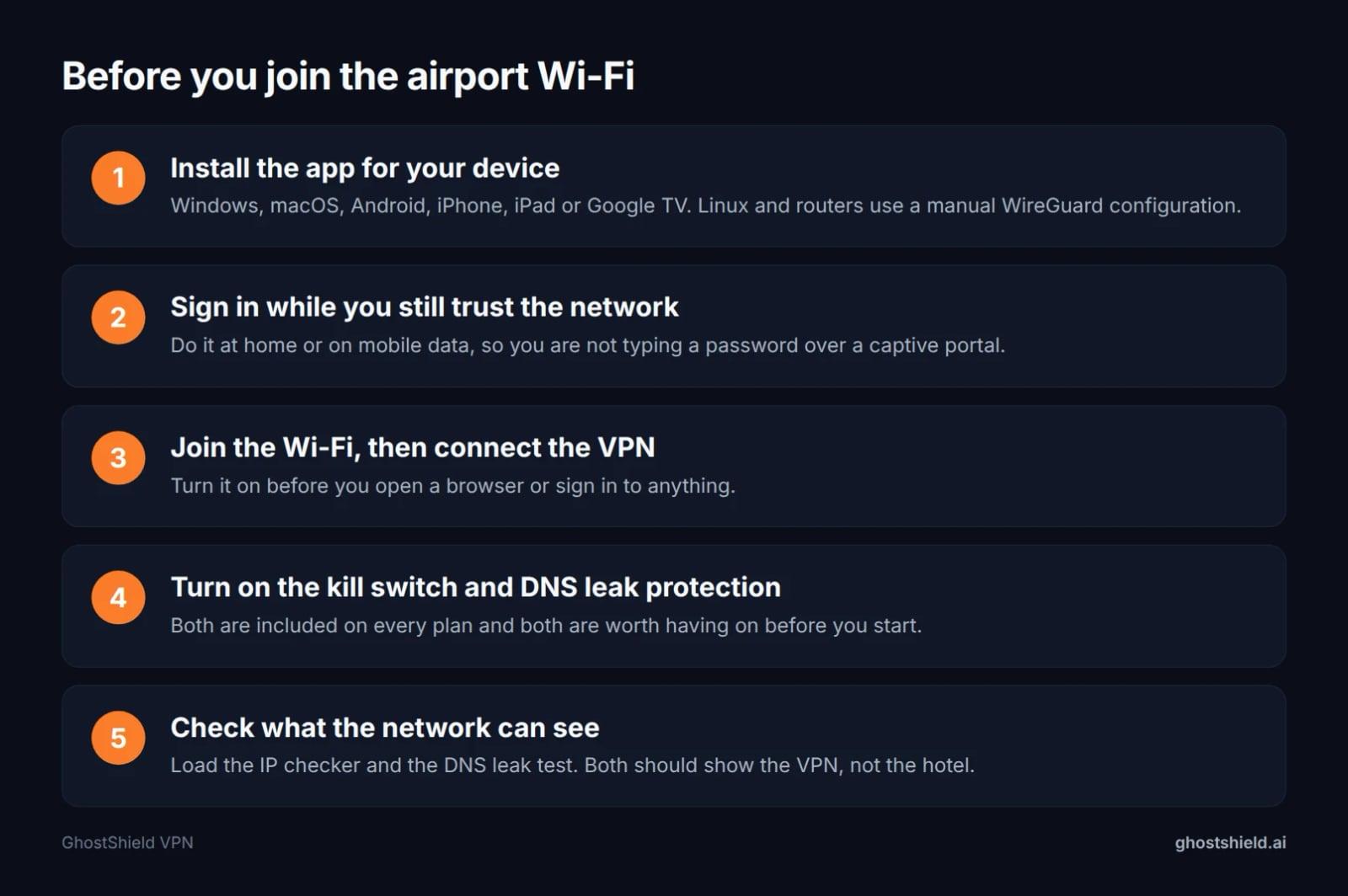
The order matters more than the settings. Install and sign in while you are still on a connection you trust, then connect the VPN before you sign in to anything on the new network.
Ten devices run on one plan, which covers a phone, a laptop and a tablet without a second purchase.
Once connected, load our IP checker and the DNS leak test. If both show the VPN and not the hotel, the tunnel is doing its job.
Our guide to working remotely safely covers the rest of the routine, from captive portals to what not to open on shared Wi-Fi.
 The order matters more than the settings.
What is the safest VPN to use?
There is no award for the safest VPN, and a list that hands one out is usually selling something. What you can do is check the same seven things on every provider.
Start with the protocol and whether the provider explains it plainly, then the logging policy and whether a third-party audit report exists and is published in full.
Then the switches you can test yourself: a kill switch, DNS leak protection, WebRTC leak protection, and split tunneling you can turn off when you need to.
GhostShield VPN has not completed a third-party audit, so we will not use the word. What we can tell you is what our policy says and what the apps do. The WebRTC leak test shows whether your browser is exposing more than the tunnel already.
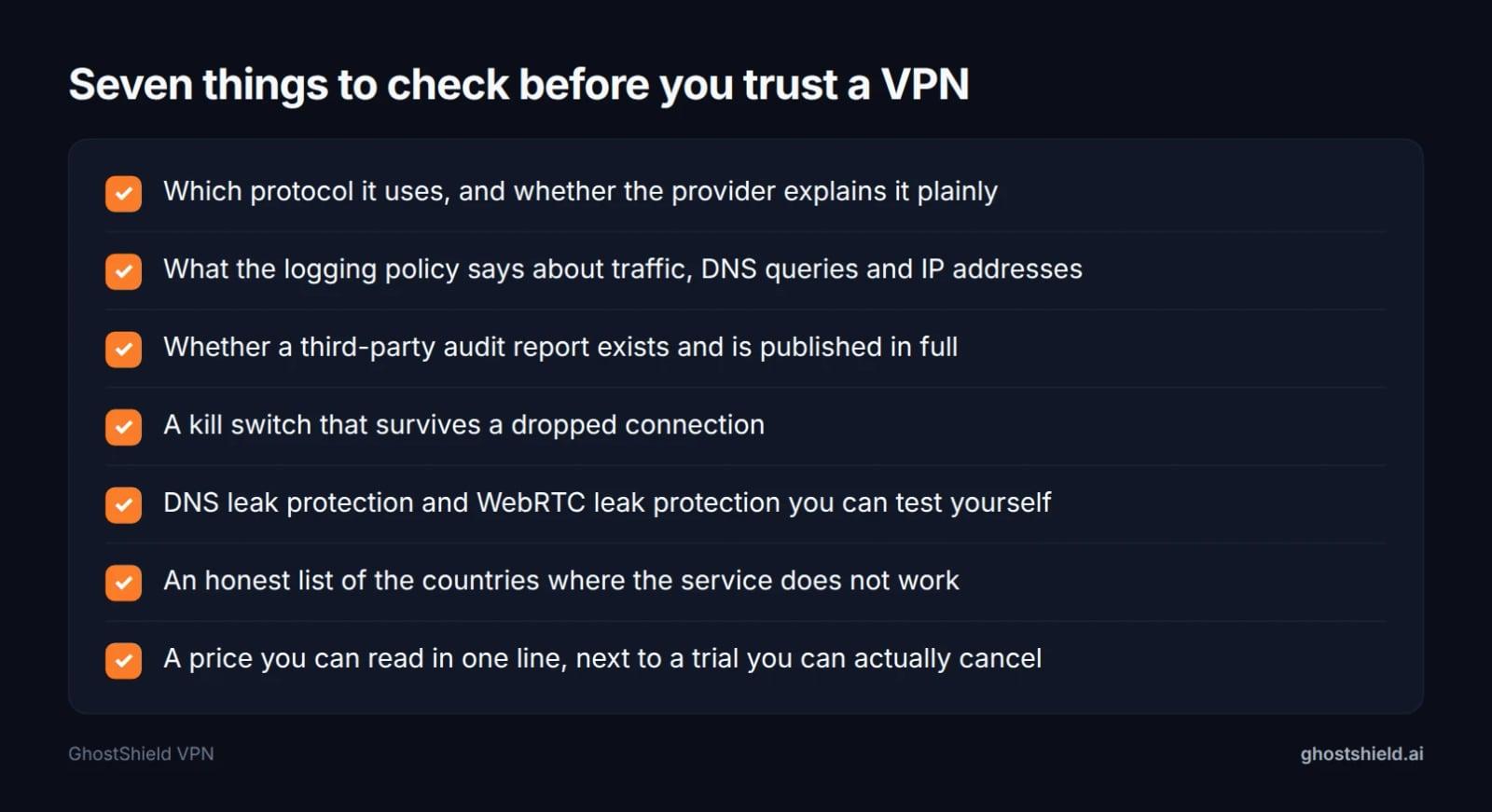 Carry this from one provider's site to the next.
Can the FBI track a VPN?
A VPN moves the point where your traffic enters the internet. Your ISP sees a connection to the VPN server, the local network sees one encrypted tunnel, and the sites you visit see the VPN server's address.
What it does not do is erase the records at either end: your account with the provider, your payment method, and the sites where you log in.
That is why the logging policy matters more than the protocol. If nothing about your traffic is stored, there is nothing to hand over. If connection logs are kept, there is. A no-logs policy is a promise until someone checks it, and our guide to how to check a no-logs claim walks through the checking step by step.
So which one should you use?
OpenVPN is for running your own server and controlling every setting. Tailscale is for reaching your own devices across networks. A consumer WireGuard VPN is for hiding your traffic on a network you do not trust.
For the third job, GhostShield VPN is $4.99 a month on the 1-year plan ($59.88 billed yearly), or $6.99 month to month. Every plan starts with a 7-day free trial, and there is a 30-day money-back guarantee and no free plan. Prices and plan details are on the GhostShield VPN pricing page.
If you came here to run your own OpenVPN server or link a home lab, this is not that product. Our VPN comparison guide will get you where you were going. Either way, read the TLS versus IPsec piece if the encryption layer itself is what you are deciding on.
FAQ
Why avoid NordVPN?
The question usually comes from someone who is switching rather than from a flaw. NordVPN is a well-known consumer VPN made by Nord Security. If you are leaving any provider, name the reason first: price, app features you do not use, or a policy you cannot check. Our post on NordVPN alternatives sorts the options by that reason.
What is the most trusted VPN in the world?
There is no ranking that makes one VPN the most trusted, and a site that names a winner is usually paid to. Trust is checkable instead: protocol, logging policy, a published audit, kill switch, leak protection, an honest country list and a price you can read in one line. Run the seven checks on any provider before you pay.
Is Tailscale a VPN?
In the broad sense, yes: it builds encrypted tunnels between machines using WireGuard. In the consumer sense, no. It connects your own devices to each other rather than routing all your traffic through a remote server.
Which is faster, OpenVPN or Tailscale?
Speed depends on the route, the cipher and the device, not on the name. zbtwifi describes WireGuard as designed for speed and efficiency, and Tailscale runs on WireGuard. But a tailnet often sends traffic device to device across distance, while a consumer VPN sends it to a server near you.
Can I run OpenVPN and Tailscale on the same machine?
Yes, they can coexist, because each one creates its own network interface. The thing to watch is routing. Do not send the same traffic through both at once, or you get a tunnel inside a tunnel and a slower, harder-to-debug connection. Turn one off when you connect the other.
Can GhostShield VPN replace Tailscale?
No. GhostShield VPN has no mesh networking, no device-to-device links and no port forwarding, so it cannot reach a NAS or a home PC behind your router. It is built for the other job: putting your traffic through a server in one of 16 countries so a network you do not trust sees one encrypted tunnel.
Related Topics
Keep Reading
IKEv2 vs IKEv1: What Still Matters in 2026

Best VPN Services 2026: Pick by What You Pay It For
VPN Protocol Ports: Full List and How to Test Yours

Tailscale vs WireGuard: Which Do You Actually Need?
Best VPN on a Router in 2026: An Honest Setup Guide