Best VPN With No Logging: How to Check the Claim (2026)
Almost every VPN says it keeps no logs, so the useful question is who backs the claim with evidence. These are the VPNs the first page of Google names most often as the best for no logging, and which site names each one:
- NordVPN: top pick at cyberinsider.com and security.org, and on allaboutcookies.org's list.
- Proton VPN: leads cyberinsider.com's summary snippet and allaboutcookies.org's list. security.org calls it the best free option.
- PIA: top10vpn.com's "Best No-Logs VPN".
- Mullvad: top10vpn.com's "Best for Anonymity".
- ExpressVPN: top10vpn.com's "Best for Beginners".
- Surfshark and PureVPN: complete allaboutcookies.org's list. security.org says Surfshark excels on smartphones.
nordvpn.com and expressvpn.com each name their own product the best. The best no-logs VPN for you is the one whose claim holds up under the checks below.
Best VPN with no logging: what the top review sites pick
The review sites agree on a short list of names, but they rely on different kinds of evidence. cyberinsider.com leans on audits, top10vpn.com on real-world events such as court cases and server seizures, and the providers' own pages on their policies and the audit firms they hired.
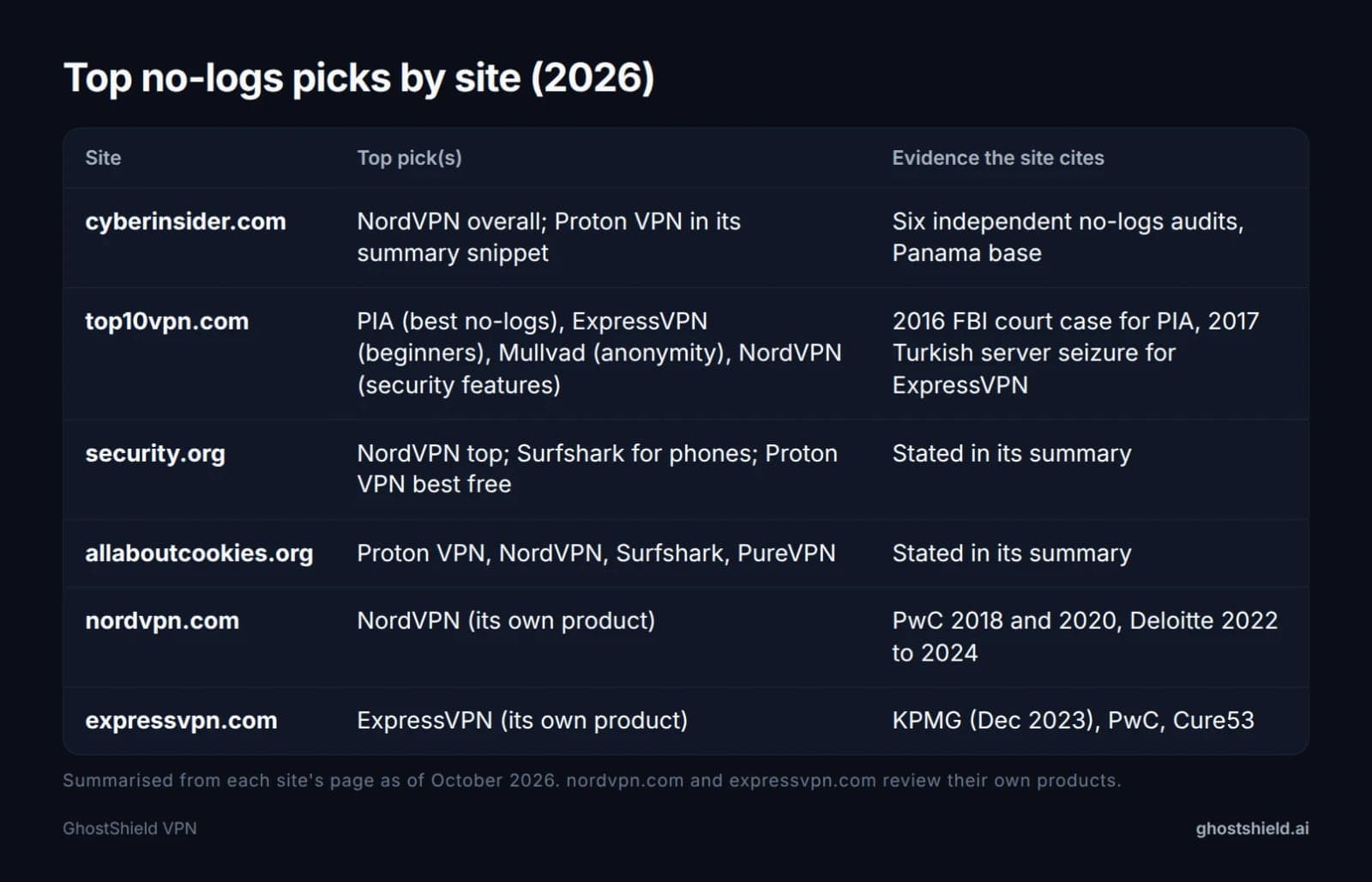 Who the first page picks as the best no-logs VPN, and why, as each site states it.
If you are choosing between specific providers, you can also compare VPNs side by side.
The top no-logs picks, one by one
Here is what the top-ranking pages report about each provider, and where they leave gaps. Treat it as a starting point, then run the checklist further down on any name you are considering.
NordVPN
- Evidence: cyberinsider.com says it has passed six independent no-logs audits: PwC in 2018 and 2020, then Deloitte in 2022, 2023, 2024 and February 2026. nordvpn.com lists the same firms.
- Jurisdiction: Panama. cyberinsider.com notes that Panama is outside the 5/9/14 Eyes surveillance alliances and has no mandatory data retention laws.
- Servers: cyberinsider.com reports RAM-disk servers and a network of 9,300+ servers in 149 countries.
- Refund: 30 days, per cyberinsider.com and nordvpn.com.
nordvpn.com also says it accepts cryptocurrency. top10vpn.com ranks it "Best for Security Features", under a heading that reads "Court-Proven Privacy with One Caveat".
Proton VPN
- Evidence: cyberinsider.com's summary describes it as a "highly secure, audited, zero-logs VPN".
- Free option: security.org names it the best free option.
- Gaps: the top pages' summaries don't detail its audit firms, jurisdiction or refund terms. Read its privacy policy and audit reports directly.
PIA (Private Internet Access)
- Evidence: top10vpn.com says its policy covers "no session, connection, or server data", and that it "had nothing to give the FBI during a 2016 court case".
- Jurisdiction: the US, a Five Eyes member. top10vpn.com scores it 4.5/10 on that single factor.
- Connections: unlimited, per top10vpn.com.
- Refund: 30 days.
Mullvad
- Anonymity: top10vpn.com calls it "Best for Anonymity", under a heading that reads "The Only VPN That Doesn't Need an Email".
- Trade-offs: top10vpn.com's next heading is "Built for Privacy, Not for Streaming", and it says Mullvad costs significantly more than PIA.
- Gaps: the top pages' summaries don't give its jurisdiction or audit details.
ExpressVPN
- Evidence: top10vpn.com says its "No-logs status proven in 2017 Turkish server seizure". expressvpn.com lists audits by KPMG (December 2023), PwC and Cure53.
- Servers: top10vpn.com says its TrustedServer technology runs the whole network in RAM. expressvpn.com says it does not store any data on hard drives.
- What it keeps: top10vpn.com says it keeps "a little anonymous data". expressvpn.com says it collects "the bare minimum" to keep connections running and fix app problems.
- Gaps: the top pages don't state its jurisdiction.
Surfshark
- Evidence: cyberinsider.com titles its section "Audited zero-logs privacy with unlimited connections".
- Jurisdiction: the Netherlands, per cyberinsider.com, which has a section on navigating its jurisdiction and the 14 Eyes.
- Connections: unlimited, per cyberinsider.com.
- Refund: 30 days, per cyberinsider.com.
What a no-logs VPN actually means
nordvpn.com defines a no-logs VPN as a tool that "doesn't keep logs of users' internet activity". top10vpn.com puts it more simply: it "doesn't record what you do while you're connected". The trouble is that "what you do" can mean very different things depending on who writes the policy.
Activity logs vs connection logs
nordvpn.com describes two main categories of logs, and expressvpn.com describes three. In practice, they fall into two groups:
| Log type | What it records | Why it matters |
|---|---|---|
| Activity logs | Sites you visit, DNS queries, traffic content | Shows what you did online |
| Connection logs | Your real IP address, connect and disconnect times, session length, data used | Can tie a VPN session back to you |
A provider can truthfully say "we don't log your browsing" and still keep connection logs. If it stores your real IP and the time you connected, someone holding those records can match your session to activity seen elsewhere.
Why "no logs" rarely means zero data
Every VPN keeps some account data, such as an email to run the account and a payment record. That is normal. The real question is whether the policy names what it collects.
top10vpn.com reports that nearly 50% of the VPNs it has reviewed log connection timestamps, your real IP address, or both. That is why the exact wording of a privacy policy matters more than the slogan on the homepage.
What audits, court cases and RAM-only servers prove (and what they don't)
The top pages lean on four kinds of evidence. Each one answers a different question, and none answers all of them.
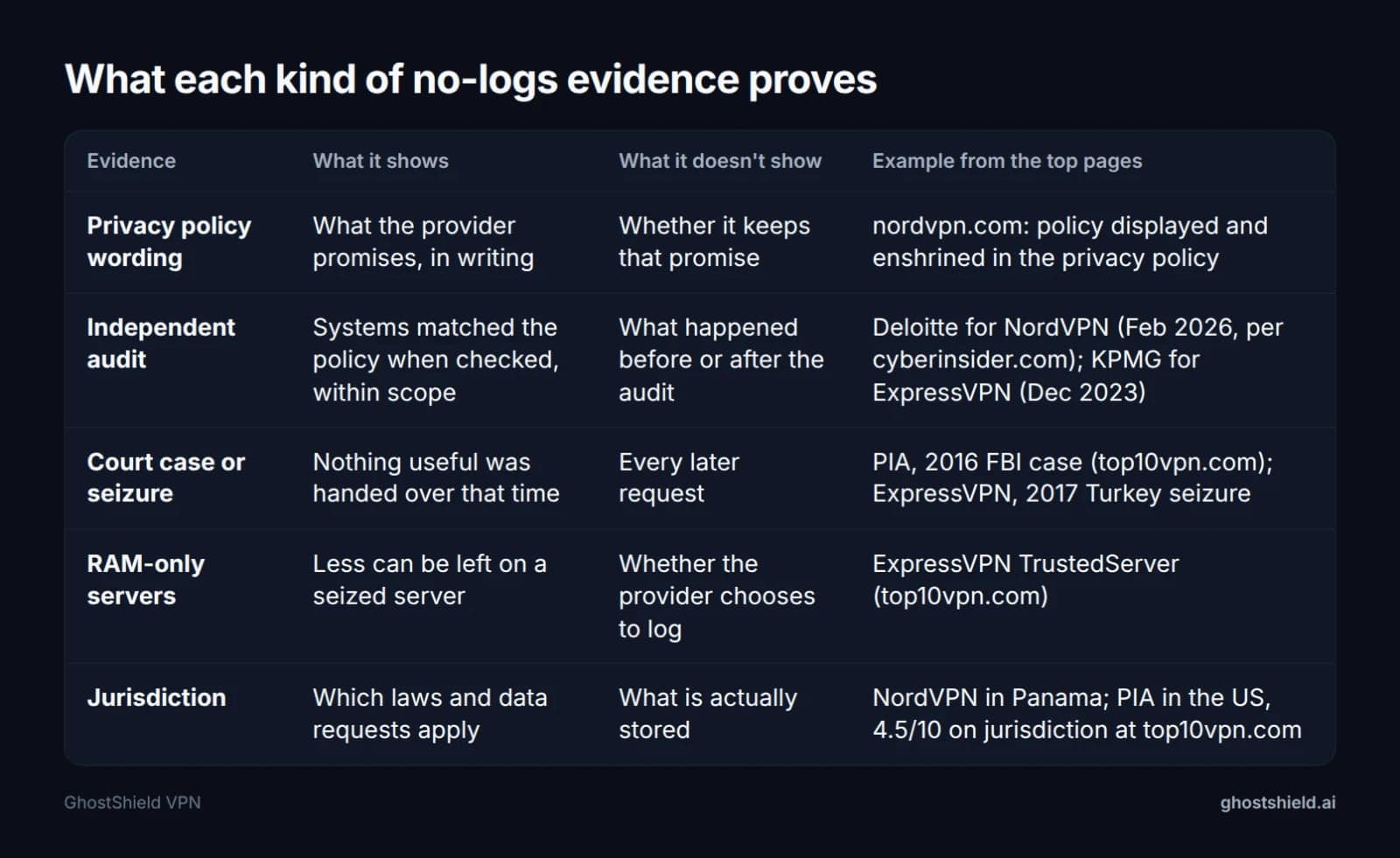 Each kind of evidence answers a different question. Stack them.
Independent audits
NordVPN and ExpressVPN both point to named audit firms, as listed above. An audit is a strong signal, but auditors check systems at one point in time and within a scope the provider agrees to. Look for who did it, when, and what it covered. A badge on a homepage is not the same as a report you can read.
Court cases and server seizures
The PIA court case and the ExpressVPN server seizure are about as strong as evidence gets, because nobody could prepare for them. Still, each case covers one moment and one request. It tells you what was stored then, not what is stored now.
RAM-only servers
RAM-only design limits what can be left on a server if someone seizes it. It does not stop a provider from logging if it chooses to, because logs can be sent elsewhere before a reboot. It is a useful safeguard, not proof of a policy.
Jurisdiction and the 5/9/14 Eyes
Jurisdiction shapes which laws apply and which data requests a provider can receive. That is why cyberinsider.com stresses Panama's lack of data retention laws and top10vpn.com marks PIA down for its US base. It does not show what a provider actually stores.
The takeaway: no single kind of proof is enough. Stack them, and use the checklist below to see which ones a provider can show you.
The 9-point checklist for testing a no-logs claim yourself
You don't need to be technical to test a no-logs claim. You need the privacy policy, a search box and about 15 minutes.
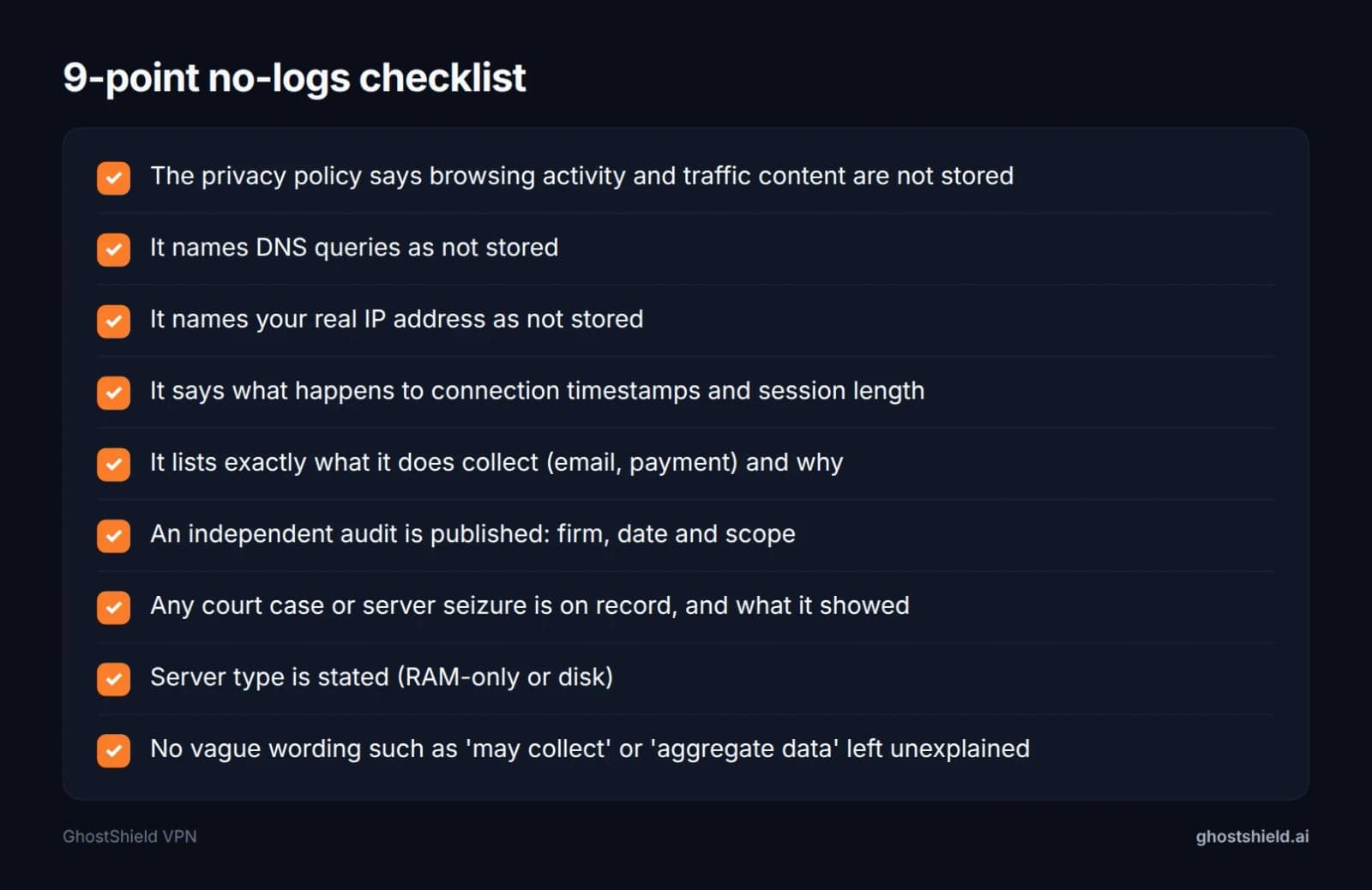 Run these 9 checks on any VPN before you pay.
What the privacy policy must name
A blanket "we keep no logs" that names nothing specific is weak. A good policy names each type of data:
- Browsing activity and traffic content. Good answer: plainly not stored.
- DNS queries. Good answer: named and not stored. DNS queries reveal every site you look up.
- Your real IP address. Good answer: named and not stored.
- Connection timestamps and session length. Good answer: the policy says what happens to them, whether that is "not stored" or "deleted after X minutes".
- What it does collect. Good answer: a list such as email and payment record, each with a reason.
What evidence to look for
- An independent audit. Good answer: a named firm, a date and a scope, with the report published or available to read.
- Court cases or seizures. Good answer: any case on record and what it showed. Having no case on record is neutral, not a failure.
- Server type. Good answer: stated clearly as RAM-only or disk. Either is honest as long as it is stated.
- No vague wording. Good answer: phrases like "may collect" or "aggregate data" are explained, not left open.
A 15-minute check you can run tonight
- Open the provider's privacy policy, not its homepage or features page.
- Use your browser's find tool (Ctrl+F or Cmd+F) to search for "IP", "timestamp", "DNS" and "collect". Read each sentence that comes up.
- Find the audit report itself. Note the firm, the date and what was checked.
- Connect to the VPN and run our free DNS leak test and WebRTC leak test.
The leak tests check your own setup, not the provider's logs. They show whether your traffic actually goes through the tunnel. A provider with a perfect policy still can't protect lookups that leak outside the VPN.
For a wider set of checks beyond logging, see our guide to the best VPNs for privacy: 7 checks to test.
Red-flag wording in VPN privacy policies
Some phrases sound reassuring but leave room for collection. Vague wording does not prove that a provider logs. It is a reason to ask a direct question, by email or live chat, before you pay.
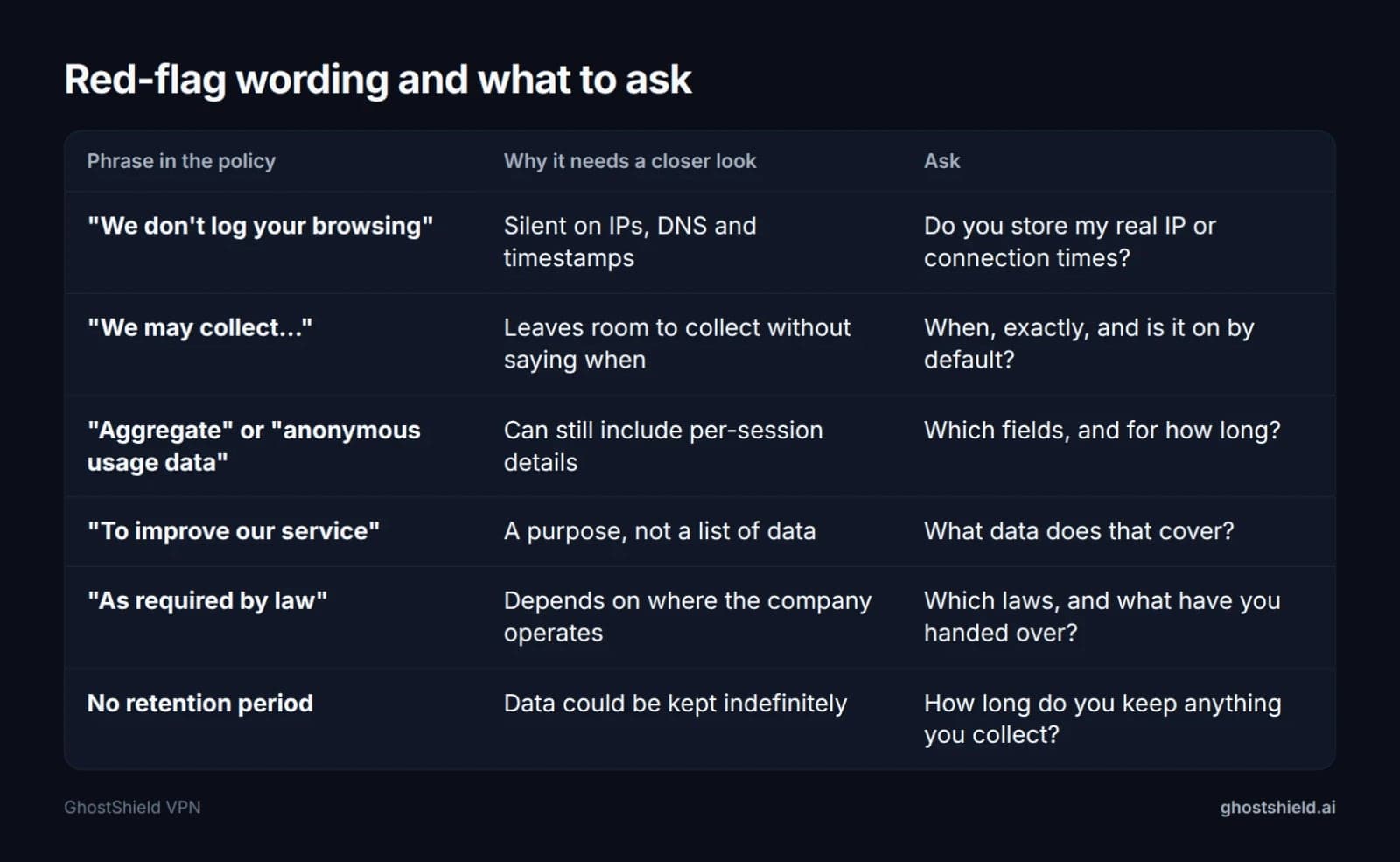 Vague wording is not proof of logging, but it is a reason to ask.
A policy is trustworthy when it lists exactly what it collects, why, and for how long. nordvpn.com makes a fair point on its own page: reputable providers state their logging practices in their privacy policy. That policy, not the homepage, is the document to read.
Worked example: GhostShield VPN against the checklist
A checklist is only useful if it applies to everyone, including us. Here is GhostShield VPN run through the same checks, with the gaps included.
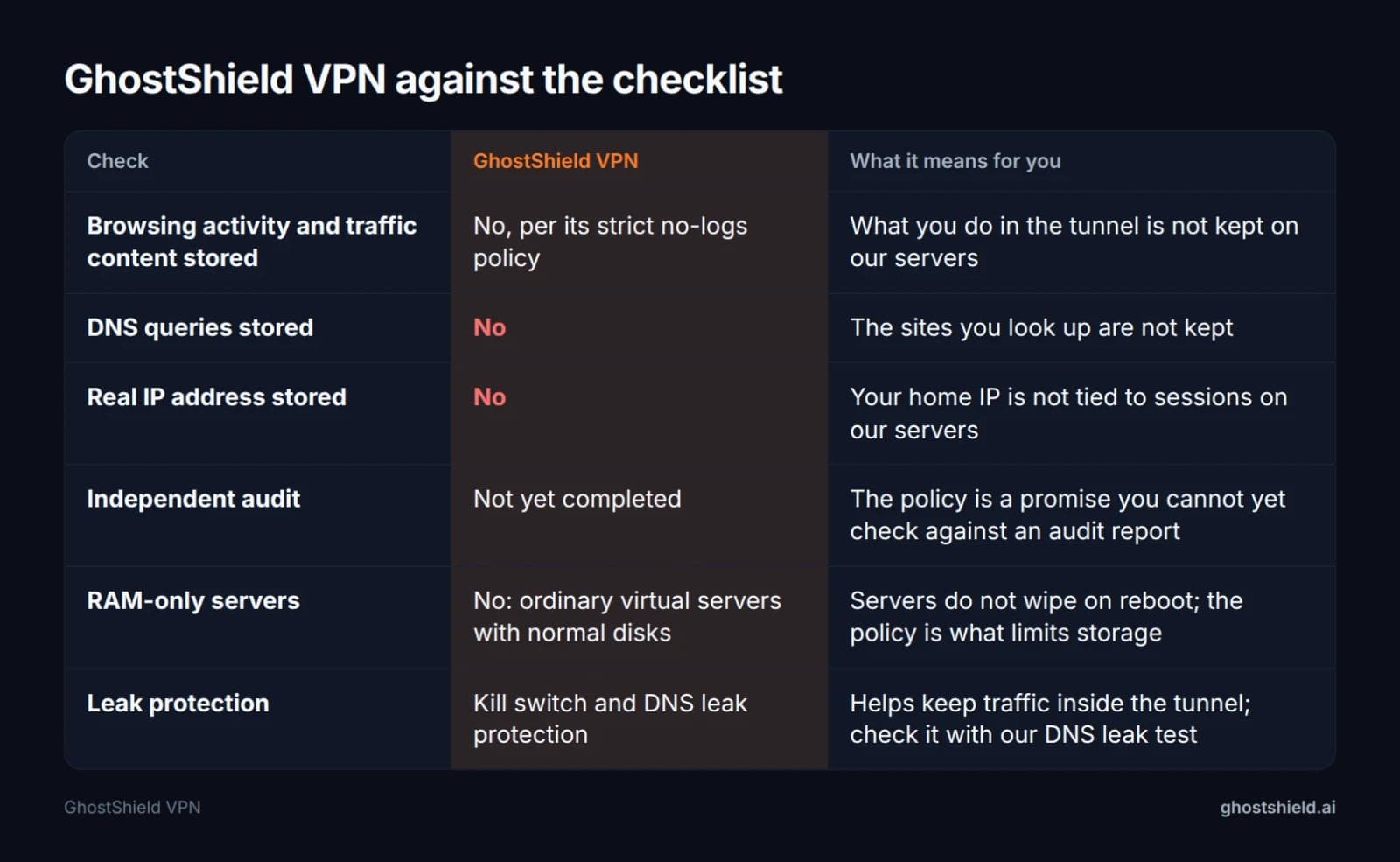 Our own product against the same checks, gaps included.
Where GhostShield VPN passes
On wording, GhostShield VPN's strict no-logs policy names what is not stored on our servers. Nothing that passes through the VPN tunnel is kept: no browsing activity, no traffic content, no DNS queries and no real IP addresses.
Leak protection is a separate check from logging, but it matters just as much in practice. GhostShield VPN includes a kill switch and DNS leak protection, which help keep your traffic inside the tunnel. You can confirm this yourself with our DNS leak test while connected.
Where it doesn't yet
No third-party audit of GhostShield VPN has been completed yet. That means our policy is a promise you cannot yet check against an audit report. Weigh that when you compare us with providers that publish one.
GhostShield VPN also runs ordinary virtual servers with normal disks. They are not RAM-only and do not wipe on reboot. What limits storage is the policy itself.
None of the ranking pages on the first page lists the gaps in its own product. We would rather you knew where we stand, and you can hold us to this list.
Can the FBI or police trace you through a VPN?
A VPN changes who can see your traffic, but it does not make you invisible.
What a VPN hides and from whom
A VPN encrypts traffic between your device and the VPN server. Your internet provider sees only that you are connected to a VPN, not which sites you visit. Websites see the VPN server's IP address instead of yours. You can check your IP address before and after connecting to see the change.
So, can the FBI see through VPNs? It cannot read encrypted traffic simply by watching your connection. However, it can go to the VPN provider with a legal request.
What a no-logs policy changes
Police or the FBI can legally ask a VPN provider for records. A no-logs policy means there should be little or nothing to hand over, as in the PIA case top10vpn.com describes.
Can the police trace a VPN? Through the provider, only if the provider has kept something that links a session to you. That is the whole point of checking the policy for IPs and timestamps.
How people still get traced
Can you be traced if you use a VPN? Yes. Most tracing happens outside the VPN tunnel:
- Accounts you log into. Signing in to Google or Facebook tells them who you are, whatever your IP.
- Payment details. Your card links your name to purchases.
- Cookies and browser fingerprinting. Sites can recognise your browser across IP addresses.
- Malware. Malicious software on your device sees everything before it is encrypted.
- DNS or WebRTC leaks. These can expose your real IP. Run our WebRTC leak test to check.
Which VPN is best for not getting tracked? No VPN stops tracking on its own. The answer is a VPN plus habits: a private browser, a tracker blocker, and staying signed out where you can. GhostShield VPN blocks ads and known malware sites, but no VPN can promise anonymity.
Free no-logs VPNs and VPNs with no log-in
On free VPNs, nordvpn.com warns that "these claims are easy to make, but hard to verify". expressvpn.com says free VPNs "often do not have a strict no-logs policy". Both are commercial sources, but the reasoning is sound. Running servers costs money, so a free service has to fund itself somehow, often through ads or data.
Is there a free VPN that requires no log-in? The first page doesn't name one that is both. top10vpn.com says Mullvad doesn't need an email, and Mullvad is a paid service. security.org names Proton VPN as its best free option. Run the 9-point checklist on either before you rely on it.
To be clear about our own product: GhostShield VPN has no free plan. Every plan starts with a 7-day free trial, and there is a 30-day money-back guarantee.
Downsides, legality and streaming
Is using a VPN illegal in the US?
No. Using a VPN is legal in the US. Anything illegal stays illegal with or without one. Some countries restrict or block VPNs, so check the local rules before a trip with our guide to VPN rules when you travel.
What is the downside of using a VPN?
There are four main ones:
- Some speed loss. Traffic takes an extra hop and is encrypted, which adds a little delay.
- Cost. Trustworthy services are paid.
- Blocks and extra CAPTCHAs. Some sites block VPN IP addresses or show challenge pages. Our post on fixes for Cloudflare challenge pages covers what to do.
- Shifted trust. Your internet provider no longer sees your traffic, but your VPN provider could. That is exactly why the no-logs checklist matters.
Will Netflix ban me if I use a VPN?
When Netflix detects a VPN, it usually shows a proxy error rather than closing your account. A VPN can help a traveller reach the library they already pay for at home, but no VPN can guarantee that any streaming service will work. Read more about streaming with a VPN.
Try GhostShield VPN with the checklist in hand
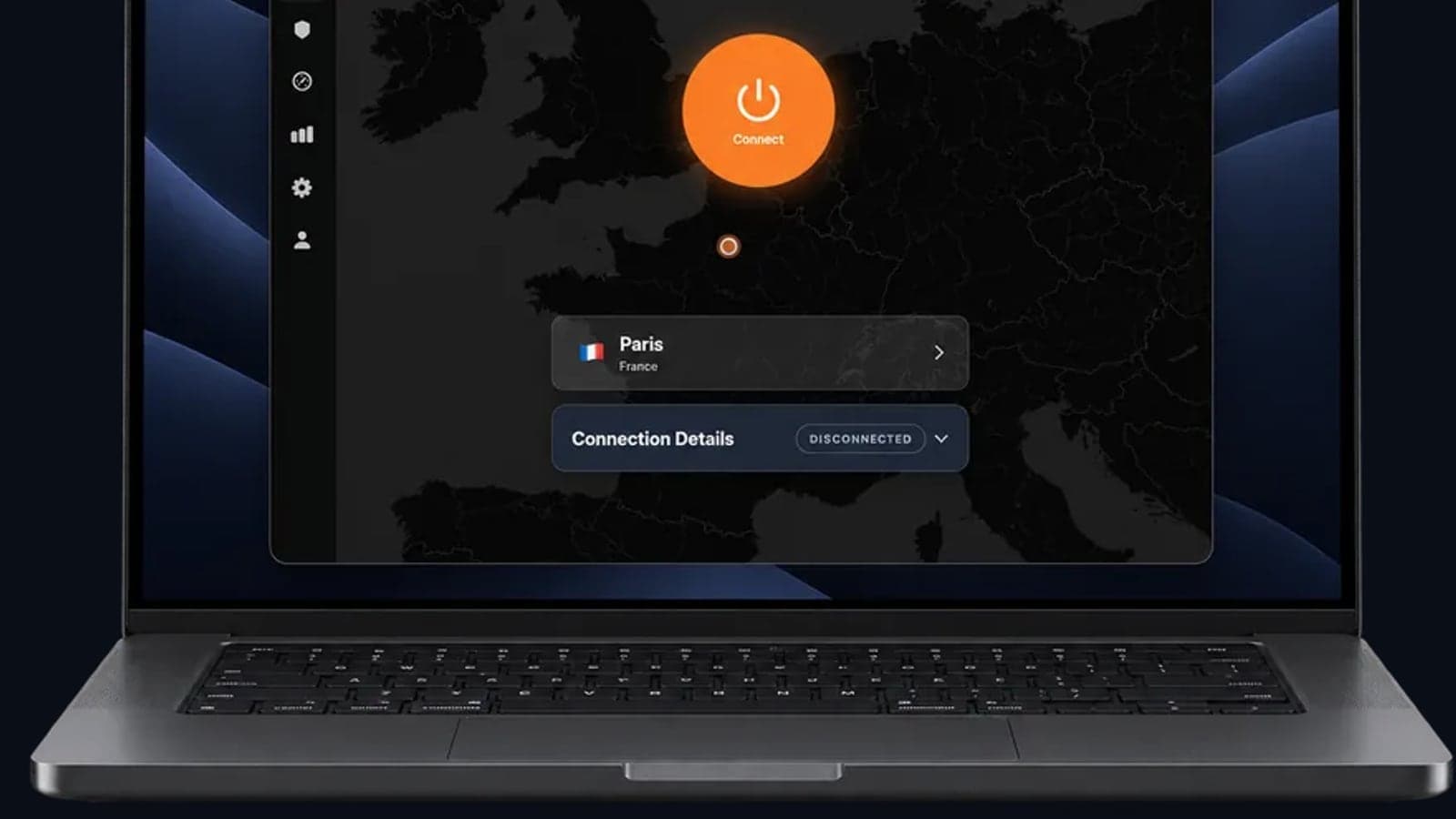
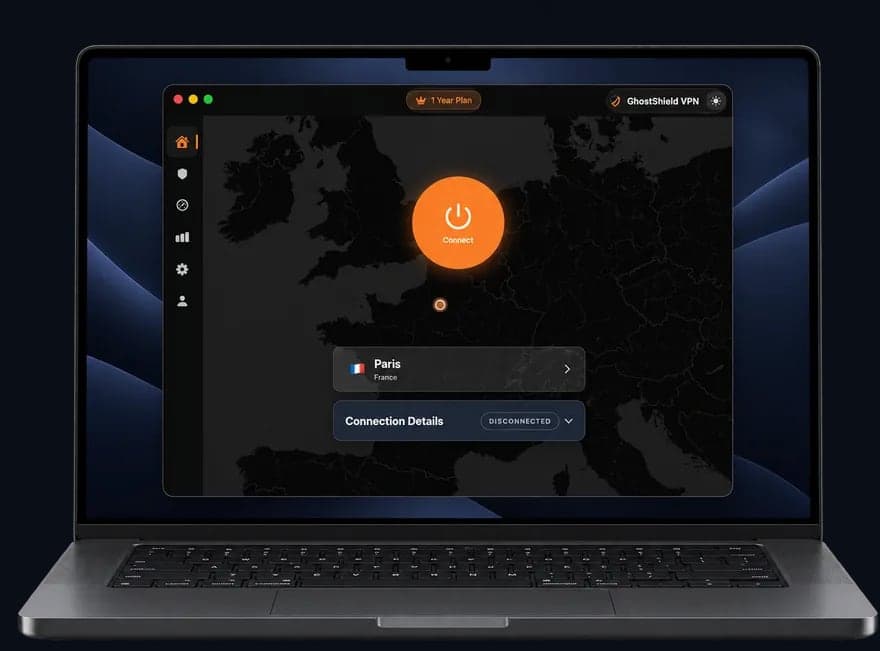 GhostShield VPN app on a MacBook
GhostShield VPN's strict no-logs policy names what it does not store, as set out in the worked example above. It uses WireGuard with ChaCha20-Poly1305 and includes a kill switch and DNS leak protection. You can connect 10 devices with apps for Windows, macOS, Android, iPhone and iPad, and Google TV. It has not been audited yet, and its servers are not RAM-only, so judge it on the checklist like anything else. The 1-year plan is $4.99 a month ($59.88 billed yearly), and every plan comes with a 30-day money-back guarantee, so you can start the 7-day free trial and run the leak tests yourself.
One limit: GhostShield VPN has no obfuscation, so it is not reliable in China, Russia, Iran or the UAE. If you are heading to one of them, read our guide to internet censorship while travelling first.
FAQ
Why avoid NordVPN?
The top-ranking pages don't give a logging reason to avoid it. cyberinsider.com and nordvpn.com report PwC and Deloitte reviews of its no-logs claims, and cyberinsider.com says it is based in Panama, outside the 5/9/14 Eyes alliances. If you are thinking of leaving for other reasons, such as price or features, our guide to NordVPN alternatives, picked by why you're leaving covers those cases.
Is NordVPN a no-log VPN?
nordvpn.com says it keeps no logs of your internet activity, and it lists PwC reviews in 2018 and 2020 and Deloitte reviews in 2022, 2023 and 2024. cyberinsider.com adds a Deloitte audit published in February 2026. As with any provider, read the audit scope and dates yourself.
What is the best VPN with no logging for iPhone or Android?
It is the one that passes the same no-logs checklist and has a solid app for your phone. security.org says Surfshark excels on smartphones. For phone-specific checks, see our best iPhone VPN checks and best Android VPN tests.
What does Reddit say is the best no-log VPN?
The top Reddit thread on the first page mentions ProtonVPN and Surfshark, "since both claim to have strong no log policies". That is one user's opinion, and it repeats the providers' own claims rather than proving them. Treat Reddit as a starting list, then check each name against the 9-point checklist.
Does a no-logs VPN make me anonymous?
No. A no-logs VPN hides your traffic from your internet provider and your real IP from websites. You can still be identified through accounts you sign in to, payment details, cookies, browser fingerprinting, malware and leaks. Pair the VPN with private browsing habits, and run leak tests while you are connected.
Does GhostShield VPN keep logs?
No. GhostShield VPN has a strict no-logs policy: nothing that passes through the VPN tunnel is stored on our servers (the worked example above lists exactly what that covers). No third-party audit has been completed yet, and the servers are ordinary virtual servers with normal disks, not RAM-only.
Related Topics
Keep Reading

OpenVPN UDP vs TCP: Which to Use, and When
TLS VPN vs IPsec: Key Differences and Where WireGuard Fits

NordVPN Alternatives: Pick by Why You're Leaving (2026)

Best Mac VPN 2026: 8 macOS Checks Before You Buy